
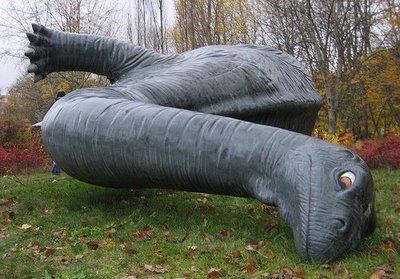
Norwich, England (Strutts News Services) – A long-debated archaeological mystery has apparently been resolved by researchers of the University of East Anglia.
The excavations of the River Yare floodplain in the early 1970s unearthed numerous fossils which gave creedence to the theory of reptilian insomnia. All fossils were meticulously labeled and their in-situ positions noted, allowing for a glimpse into the sleeping habits of the great reptiles.
Janessa Vapors of the UEA described the find as, “one of the most important discoveries of modern times. With very few exceptions, 50% of the orbital sockets point up. This gives credence to the brutal global warming of the cretaceous period, where it was just too hot to sleep. They died with their eyes open, and that’s where we’re headed.”
Archaeologist Dr. Paul Kuyperbelt of the Natural Dilatory Institute disputes this hypothesis. “We’ve been asking to examine the fossils and data for several years now and we’ve been stonewalled at every turn.” Kuyperbelt stated that Vapors (et. al.), after collecting their data, used the crushed fossils as aggregate base for their parking facility.
Via telephone conversation, Vapors responded with, “Well, duh. The land was swampy, and we’ve got a limited budget. We considered it to be recycling, giving back to the earth. At least we spared the brachiopods.”
[Found here. Related post here.]

 Tacky Raccoons