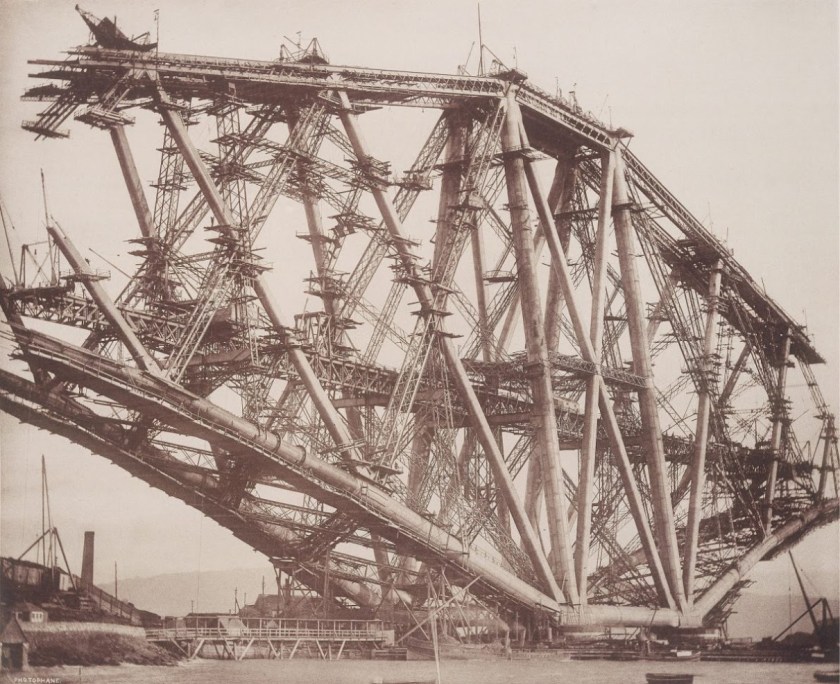
The Fife Cantilever

‘The Fife cantilever’, c 1880s.

Photograph of the construction of the Forth Railway Bridge in Scotland. Undoubtedly Britain’s most famous railway landmark, The Forth Bridge was opened by HRH The Prince of Wales in March 1890 following eight years of building, and completed the east coast railway route between London and Aberdeen. It spans the Firth of Forth, joining the city of Edinburgh and Fife in Scotland. The bridge was designed by Sir John Fowler and Sir Benjamin Baker, and built by engineer Sir William Arrol. It contains almost 54,000 tons of steel and when completed, the 1.5 mile long bridge was the biggest in the world. It is the world’s oldest cantilever railway bridge and remains in use to this day.

[Image from Feral Irishman‘s awesome rotating banner. Description from here.]
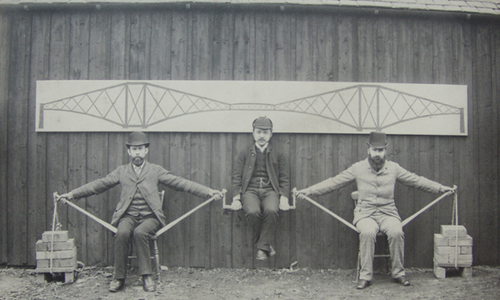
Tension and Compression

Tension & Compression

A demonstration of the mathematical principles of the original Forth Bridge in Scotland performed at Imperial College in 1887. The central ‘weight’ is Kaichi Watanabe, one of the first Japanese engineers to study in the UK, while Sir John Fowler and Benjamin Baker provide the supports.

Long-span structural engineering illustrated. Note that weight is not the problem with this truss, but uplift is, hence the weights at the extreme ends of the truss. Tension is transferred from the exterior weights through the arms of the two men near the ends of the span, while compression struts keep this structure from collapsing under the dead weight of Mr. Watanabe.  Note also that without the weight provided by Mr. Watanabe, this structure collapses (unless Messrs. Fowler and Baker scooch over and hold hands).

[Found here.]