


[Found here, here and here. Related sweded .gif in here.]

When a capabara clicks and huffs, it’s angry and this one is really pissed at the snow.
The Utoobage videos entitled “Doodling In Math Class” are pure awesome. This one relates the Golden Rectangle and irrational number Phi to botany.
Miles Davis, live in Munich 1988. I saw him in the early 80s, and the performance was amazing. Nice groove here.
Late posting this – got kind of busy with other stuff last night. Have a great weekend, see ya tomorrow.
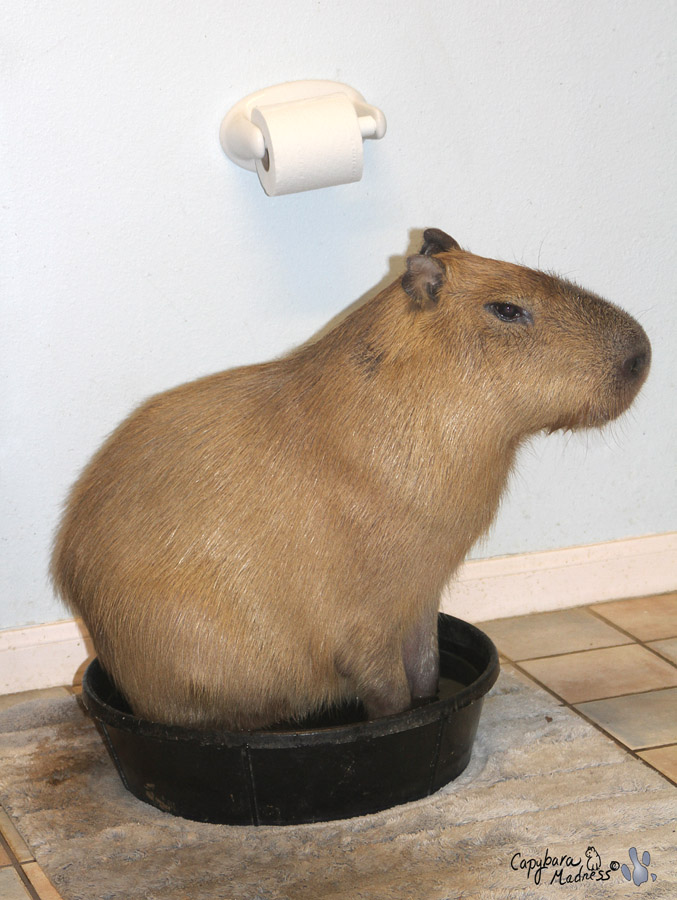
Step 1: Get a capybara.
Step 2: Enjoy.
[Found here. Related capycrap here.]
[Update: Got a huge number of hits on capys today, and here’s why.]

Yep, that’s a capybara, and those are monkeys. Cebus albifrons Zappafrankinus monkeys to be exact.
[Found in here. Like capys? We added a new category just for you.]

“Capybara sits on a lady’s knee;
Merry, merry king of the bushy sea.
Lap, capybara! Lap, capybara!
Warm my lap for me.”
Oh wait. That’s the kookaburra song. Australia, Argentina, what’s the difference. Nevermind.
In any case, that’s a big ‘ol honkin’ rodent she’s got there. Think twice or more before you decide that they’re just large guinea pigs:
“Do not let the capys out unless it is within a pen. They will run…they are very fast. It’s best to put the carrier in the pen and open the door. You may have to dump it out because it will hide as far back in the carrier as it can get.
“Remember … this wild animal will go in all directions to get away. It will hit the fence several times, settle and start walking the fence to find a way out. If they have a source of water that will be the first place it will go. If there is a sign of danger in the wild capys escape to the water. They will hide under and around objects.
“Do not concern yourself if they do not eat for a day. Give them a corn on the cob and they will start eating. Any fruits/veggies are fine for them to eat. They need to be fed twice a day with treats around for them to snack on if they get hungry
“They rest a lot during the day and are more active in the evenings. They often have runny stools… do not worry as it is what they eat.
“Do not grab them by the hind legs as you might dislocate a leg. Hold them with your hand and arm under their belly and hand under their neck. Cuddle them and they will settle.”
Note that she’s got a towel to protect herself from runny capyoopsies. Definitely don’t want to mess up that fine upholstery either.
[Image found in here. Quotation found in here.]
[Update 10:30AM – The Capybara Posting Police are out. See comments below for clarifications.]
[Update 2: We’ve added a special blog category just for you Capy fans.]
Update 3: Here is Caplin Rous (the one in the photo) in action.

 Tacky Raccoons