You Are Here. Or Not.

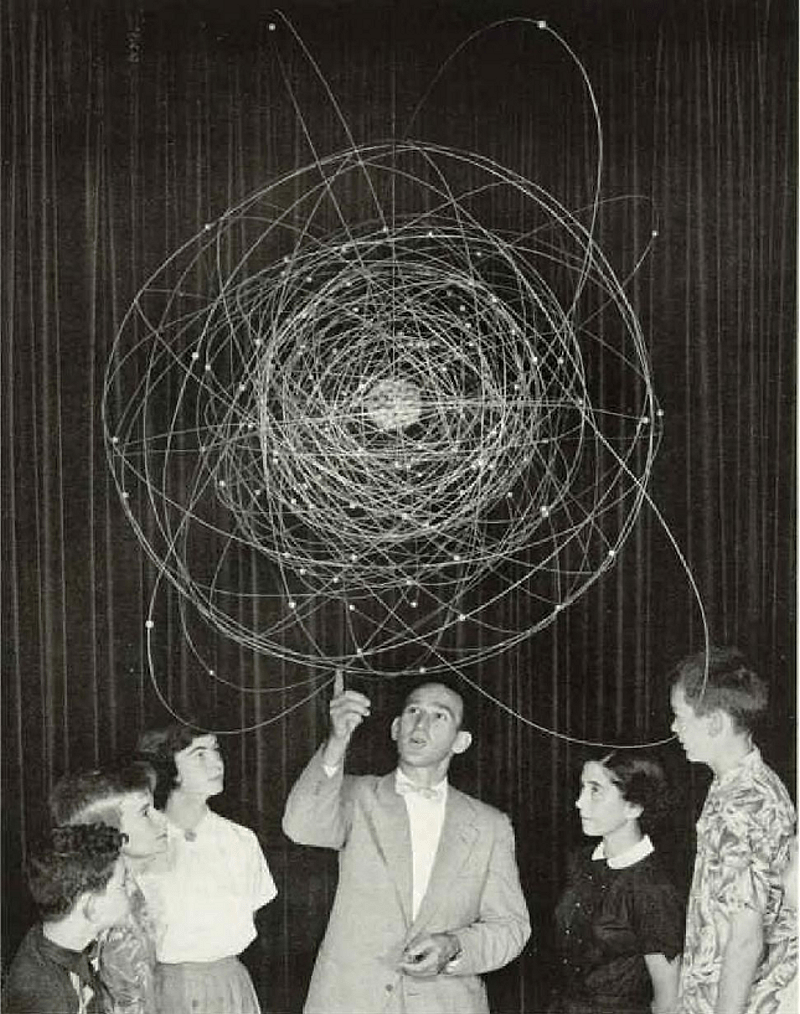
Uranium Atom’s Tightly Clustered Core Is the Main Source of Atomic Energy
Shown in Boston’s Museum of Science, this model depicts radioactive uranium 235, whose nucleus contains 92 protons and 143 neutrons. Nonfissionable uranium 238 carries three additional neutrons. Both are isotopes, or variants, of Nature’s heaviest element. Balls bunched in the center represent the protons and neutrons, which are mysteriously bound together by atomic energy’s terrific force. Splitting of the nucleus releases energy far greater than that of any chemical reaction. Wire-strung balls swinging like planets around a sun represent uranium’s 92 electrons. Hydrogen, in contrast, has one. True scale would place the outermost electrons 3,000 from the center.
[Image ca. 1954, with caption, found here via here.]

The Real Story?

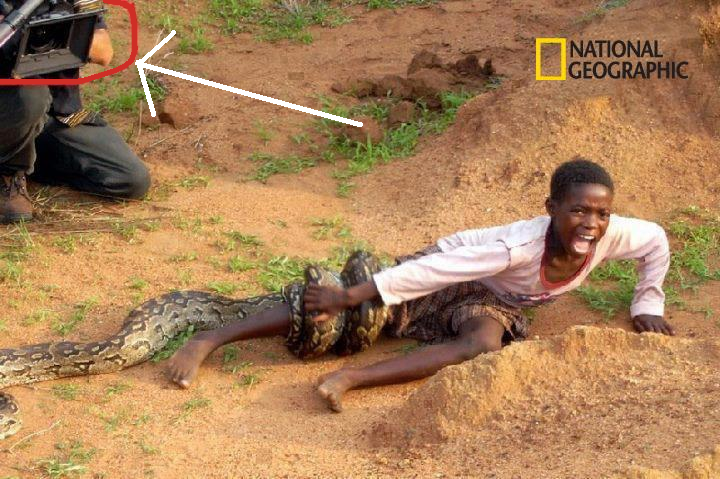
Huh. The kid is eye-bawling directly into the other cameraman’s lens to show his pain, but I suspect that the snake was already dead. Is that a genuine un-cropped National Geographic photo? I don’t know, Babs, but I do know this.

NatGeo changed several years ago when her new editors veered from illuminating the fascinating fields of anthropology, zoology and botany, and began promoting the pop pseudo-science absurdity that “humans-are-destroying-the-universe.”

Now will someone please remove the snake carcass from that kid’s leg before he depletes his acting skills?

[Found here.]

NG Almost Picks Up Strutts News Services Story

indricotheria-nationalgeo-2.jpg

Zanesville, Ohio (Strutts News Services) –

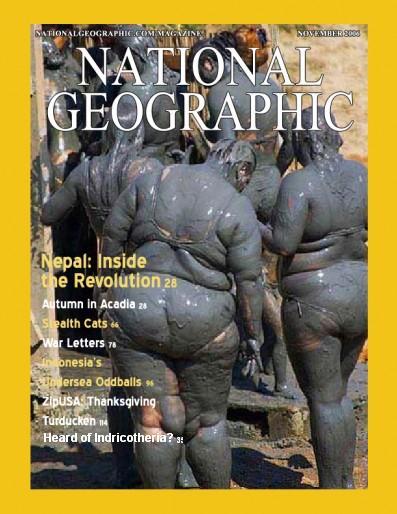
This month’s issue of the National Geographic was originally designed to feature the award-winning photo and story of the herd of captured Indricotheria, as first reported to TRITE (TackyRaccoons Investigation Team East, Strutts News Services) by doctoral candidates Mr. Lannie Foosers and Ms. Toonci Crumbler of the Cerro Gordo Oceanic Institute on this very website.

Foosers and Crumbler were all jumpy and jivey excited until they discovered that their ground-breaking contribution was neither acknowleged by National Geographic Magazine, nor was the story with the now-famous accompanying photo even published.

NatGeo Senior Apprentice-Editor-In-Training Bob “Bobby” Bieber explained his decision to spike the story. “The claims in the full-page NexLoid Chromioplasty advertisement were easier to confirm, so we shelved the Indricotheria blurb for now.”

[Okay, okay… NatGeo cover is from MagMyPic, and then I messed with it just a little. Still missing the original source for the original photo of the Indricotheria.]