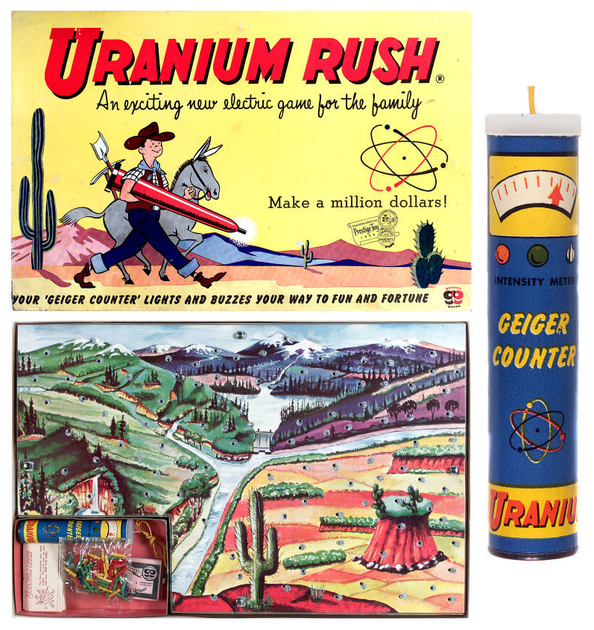
Make a Million Dollars

“Uranium Rush was an ‘educator approved’ game from the 1950s. Players begin with $15,000 and prospect for uranium in an area determined by a spinner (mountain, hills, or desert). Claims can be purchased for $1000 each and may be auctioned off or tested for uranium. This involves an electric ‘Geiger counter’ that produces a buzzing sound if uranium is discovered. The claim is then sold to the federal government for $50,000. Players alternate turns until all claims have been staked and the person with the most money is declared the winner.”

Produced by Gardner & Co. (Gardner Games) in 1955.

[Found here.]
You Are Here. Or Not.

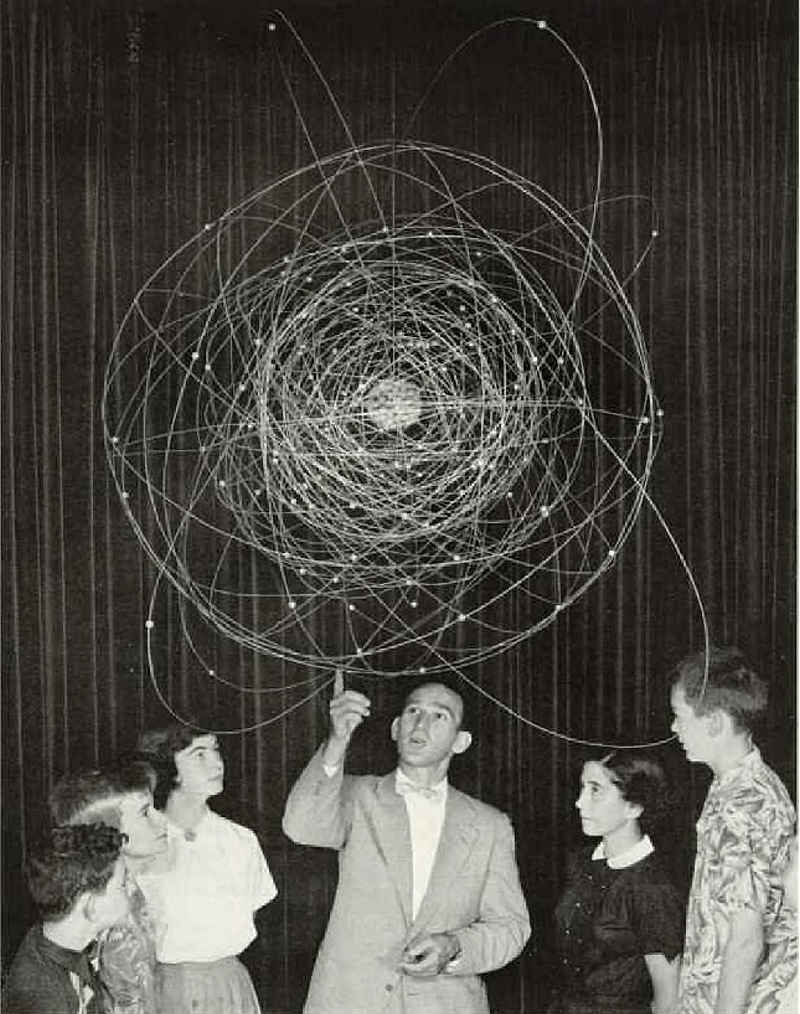
Uranium Atom’s Tightly Clustered Core Is the Main Source of Atomic Energy
Shown in Boston’s Museum of Science, this model depicts radioactive uranium 235, whose nucleus contains 92 protons and 143 neutrons. Nonfissionable uranium 238 carries three additional neutrons. Both are isotopes, or variants, of Nature’s heaviest element. Balls bunched in the center represent the protons and neutrons, which are mysteriously bound together by atomic energy’s terrific force. Splitting of the nucleus releases energy far greater than that of any chemical reaction. Wire-strung balls swinging like planets around a sun represent uranium’s 92 electrons. Hydrogen, in contrast, has one. True scale would place the outermost electrons 3,000 from the center.

[Image ca. 1954, with caption, found here via here.]