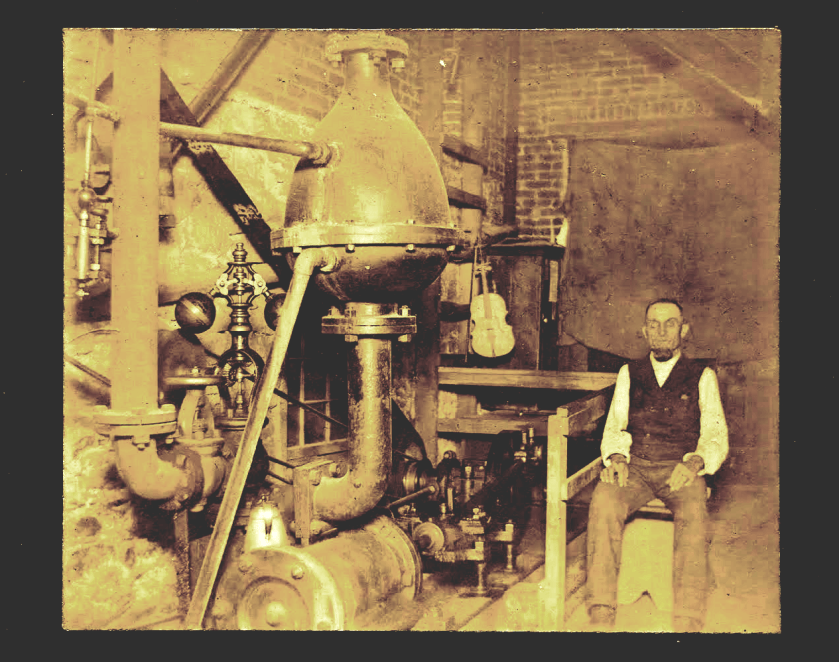
He was a musician as well.
[Found here.]
[UPDATE: That’s not a still. It’s apparently a steam engine. See comments below.]


He was a musician as well.
[Found here.]
[UPDATE: That’s not a still. It’s apparently a steam engine. See comments below.]
 Tacky Raccoons
That is a small steam engine probably driving an overhead
line shaft for a small plant or machine shop. The clue is
the angled belt on the left side of the photo.
LikeLike
Leonard– You may be right. It looked like a thumper and condenser to me, and the description came from the source image. I’ve forwarded your observation to the source for response.
http://dulltooldimbulb.blogspot.com/2019/03/occupational-vintage-photo-whiskey.html
LikeLike
I know of no still that has a reciprocating steam cylinder,
a crosshead, a mechanical governor, a pulley and a
lineshaft belt. Whoever captioned the image at the
link got it wrong.
I have rebuilt simplex and duplex reciprocating steam
pumps as well as rotary steam turbines. The governor
controls the steam flow via the inlet valve and the
discharge line is piped to the condenser, which is
indicative of a steam engine.
The condenser on a multi-thousand HP turbine I worked
on was so efficient, it was drawing a near perfect vacuum
on the discharge line. It is not just about the steam
pressure, it is also about the flow. If you are pulling
a near perfect vacuum at the discharge, you are at the
edge of efficiency.
LikeLike
Leonard–
I get it. Post your comment on the link above, and we’ll see if we get a correction.
LikeLike
OK, I did it, but I doubt the person who posted this disinformation
has spent one minute in the mechanical trades. Stills are basically pressured vessels with condenser coils. This image has a piston,
a steam cylinder, a late 19th to early 20th-century mechanical
governor, a crosshead and rod, and a line shaft pulley and belt,
not one of which is found on moonshine stills!
The condenser is the only thing a still has in common with a
steam engine. I worked on steam engines in my mid to late
20s. They are still used to power reciprocating fluid pumps
anywhere steam is used in a production process like a chemical
company or an oil refinery.
This is most assuredly not a still. You can see the inlet and
exhaust lines on the lower left and the mechanical governor
in the inlet line, as well as the condenser on the exhaust line.
The governor serves to regulate or more precisely modulate
the steam pressure so as to maintain a constant RPM for the
steam engine.
Sorry, but as I said before I worked on steam engines.
If this were a still, it would two components, a pressure
vessel (most often wood fired) and a condensing coil,
usually consisting of copper pipe coming out of the top
of the pressure vessel. More efficient stills might have
water or fan cooled condensers to speed up the output
volume but no still has pistons, cylinders, or crossheads!
LikeLike
Leonard– Thanks for the update. I don’t think the source (Jim Linderman) intentionally misidentified the machine. His original photo is faded – I enhanced it a bit before I posted it here, and it shows more details that I glossed over but you caught. Thanks.
LikeLike
No matter what it is, exactly, you give interesting discussion. The gentleman sitting beside the whatever, seems wholly unconcerned with same.
LikeLike
doublegen– I think the photographer told him not to blink, so he kept his eyes closed and clenched his toothless jaw.
LikeLike