Yep, cars are safer now, but what a waste of a classic. Click on the image to see the test video that includes cameras inside each vehicle during the collision. [Animated .gif previously posted here.]
[Confidential to Tasha A.: Czech your email. Je ne sais quoi indeed. -Bunk]
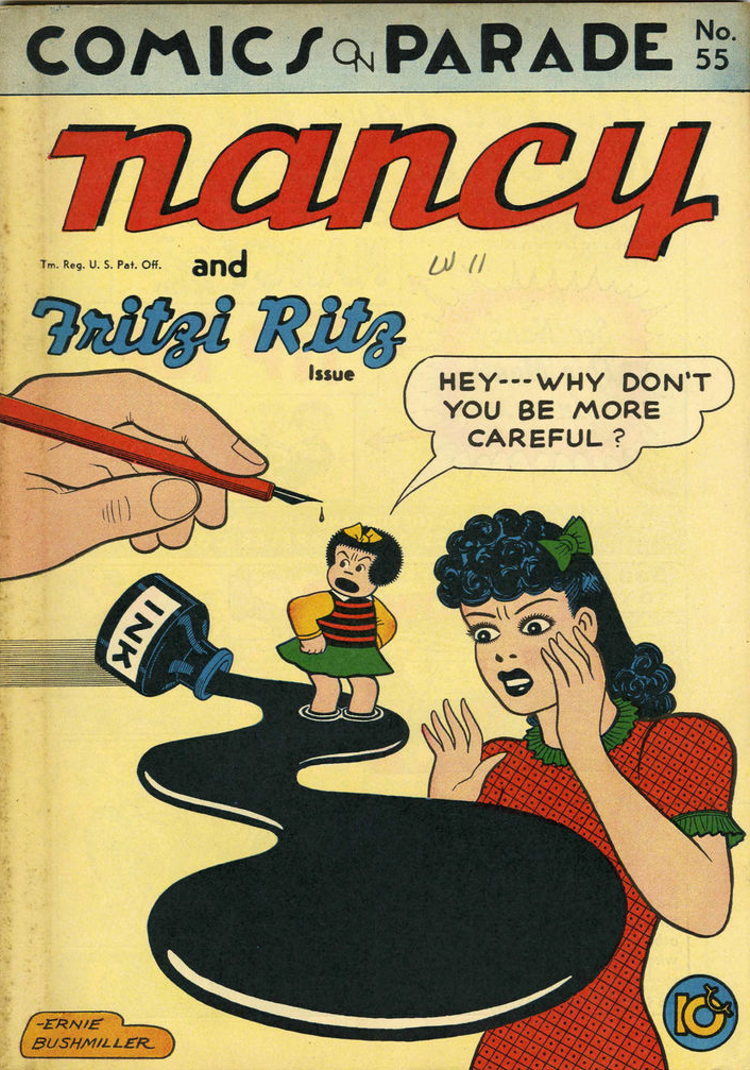
Ernie Bushmiller was one of the most surreal cartoonists of his time, and this is a good example. Nancy’s and Sluggo’s bodiless heads pop up from side-by-side Jack-in-the-Boxes without any indication of who or what flipped open the latches simultaneously or why.
Nancy’s parents never appeared in the comic and their absence was never explained; her only caretaker was her Aunt Fritzi.
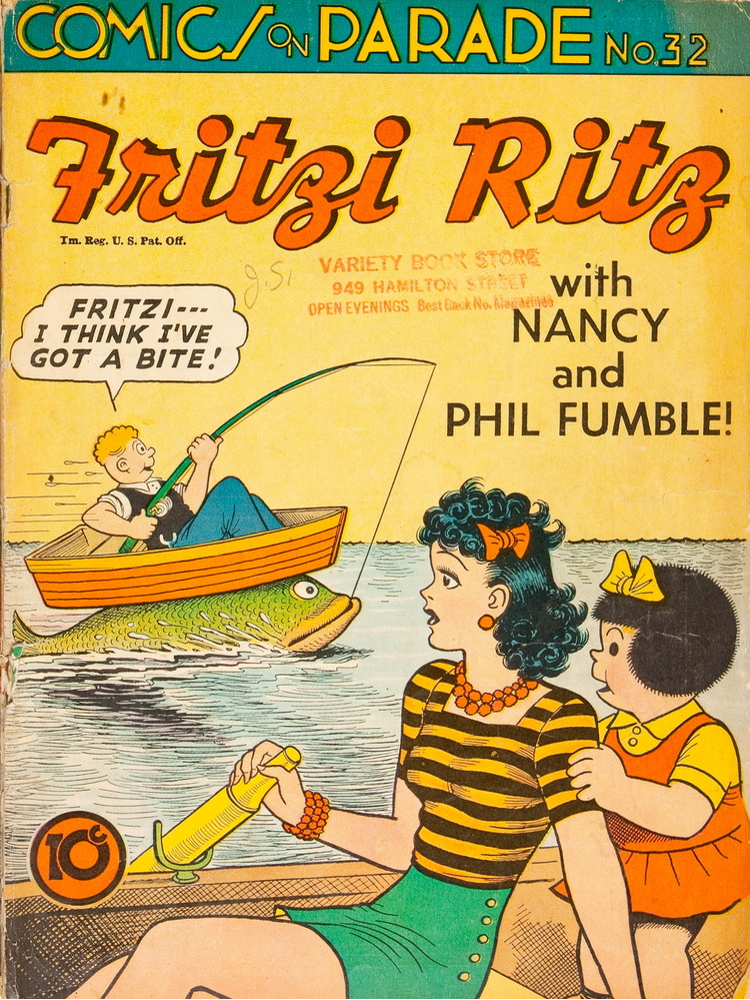
Fritzi Ritz was once an elite party girl, a flapper, who predated the Nancy comics by a few years until Bushmiller took over the strip created by Larry Whittington in 1922. Bushmiller modeled Fritzi after his own fiancée (according to Wiki) and Aunt Fritzi eventually served as Nancy’s benefactor and disciplinarian. We can assume that she recognized Nancy’s psychosis, even though Fritzi was not quaified to raise a child with mental troubles. Although not an ideal model for a young child, Fritzi did the best she could given the circumstances.
[Images found here and here. BTW, Sluggo didn’t appear until 1938, and his last name was Smith – fun facts to know and tell. Related Nancy stuff here.]
Both my grampas had stroppers in their bathrooms, and they weren’t used for disposable blades. They used straight razors with a cup of hard shaving cream and a brush. Put a little water in the cup, brush up a lather, then pay attention.
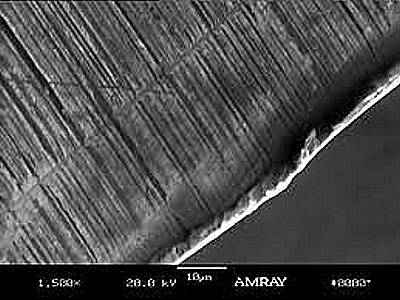
For those of you who grew up later than I did, the strop was a strip of leather hanging by a ring adjacent to the barber’s chair. Barbershops still had them when I was a kid, and they were used to get rid of a used blade’s microscopic burl:
Pushing hay [via]. Makes me itchy just watching it.
“The Ballad of Holland House” is based upon a true story.
Holland Island sits in Chesapeake Bay, near Wenona, Maryland. The five-mile-long island was settled in the 1600s, and at one time had a population of 360 people and 70 buildings. Erosion ate away at the island, which sat on silt and clay, and the residents moved away between 1914 and 1918. The island’s church was moved in 1922, and only one house remained standing. It was built in 1888. For decades, the water ate away at the island, and the last remaining house finally collapsed in October of 2010. What’s left of the island is now a marsh, home to hundreds of sea birds. See pictures of the island and the house -and the cemetery- at the Baltimore Sun[via].
Here’s another onefrom 1978, called “the first postmodern ruin.” I visited the latter ten years after construction and it was a crumbling bio-hazard with human feces in the dry pools.
The Spelling Nazi Reports:
“We hold these truths to be self-evident, that all men are created equal, that they are endowed by their Creator with certain inalienable Rights, that among these are Life, Liberty and the pursuit of Happiness.”