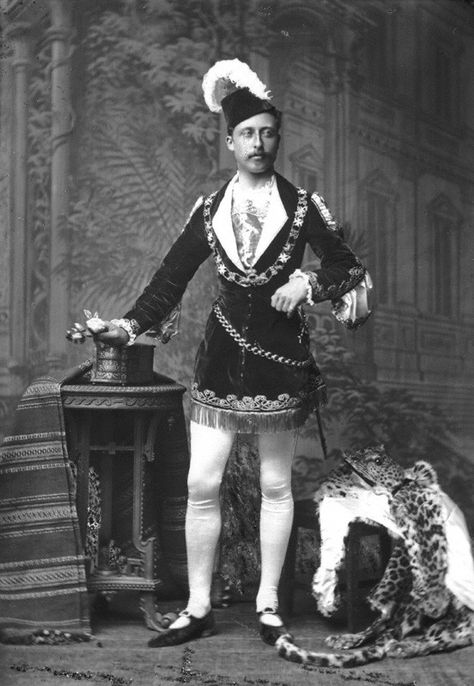
Arthur William Patrick Albert, aka Prince Arthur, Duke of Connaught and Strathearn, son of Queen Victoria and Prince Albert, circa 1874.
That photo wasn’t good enough for him, so he upped the ante.
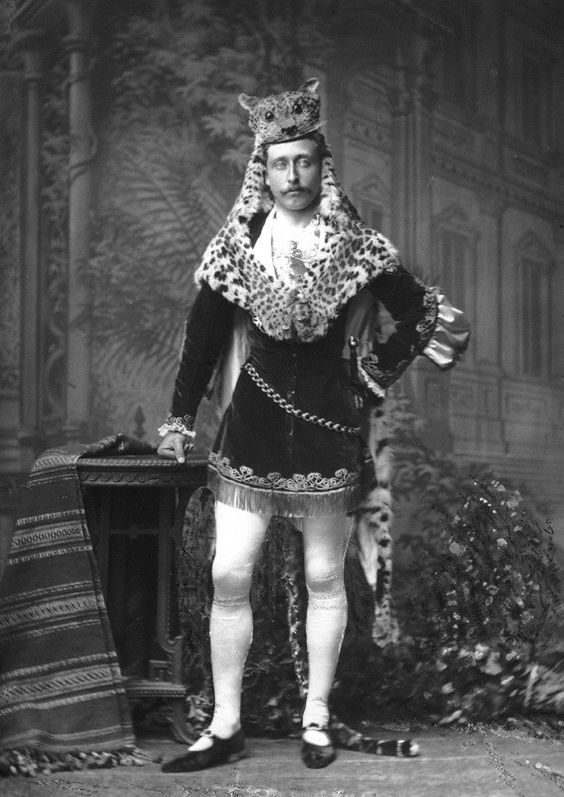
Yeah. That rocks. Much better.
[Found here.]

Arthur William Patrick Albert, aka Prince Arthur, Duke of Connaught and Strathearn, son of Queen Victoria and Prince Albert, circa 1874.
That photo wasn’t good enough for him, so he upped the ante.
Yeah. That rocks. Much better.
[Found here.]

Archie McFee’s Rubber Chicken Choir. Related link here.
We Build The Wall is under attack by faux environmentalists.
[UPDATE: Commenter Stan noticed that the site’s link doesn’t link properly to the story. Here it is.]
Titania McGrath: One of the best satirical accounts that hasn’t been permanently banned from Twitter: “Heterosexuality was invented by patriarchs as a means to justify their subjugation of women.” 😀
From The Gabba Gabba Hey Dept:
End Of The Century official trailer.
The Curse of The Ramones. Mikal Gilmore lifted most of his material from the 2003 documentary for his 2016 article published in Rolling Stone.
Read Article I Section 2 Clause 5 of the U.S. Constitution.
The House of Representatives shall chuse their Speaker and other Officers; and shall have the sole Power of Impeachment.
If you’re 18 or older, now is a good time to re-read The Bill Of Rights.
No time for that? Constitutional lawyer Mark Levin breaks it down in only 6 minutes.
From the Archives: 1 year ago. 5 years ago. 10 years ago.
[Top image: That’s one person’s approximation of the visual effect of a “visual migraine.” They are generally infrequent, usually benign, and last 20-30 minutes. Mine are similar, but look like a thin flashing jagged semicircle of neon white and sky blue shiny tinsel that starts small and gradually expands. No headaches, just temporary visual perception oddness.]
That’s my late dad’s stamp that he put on most correspondence.
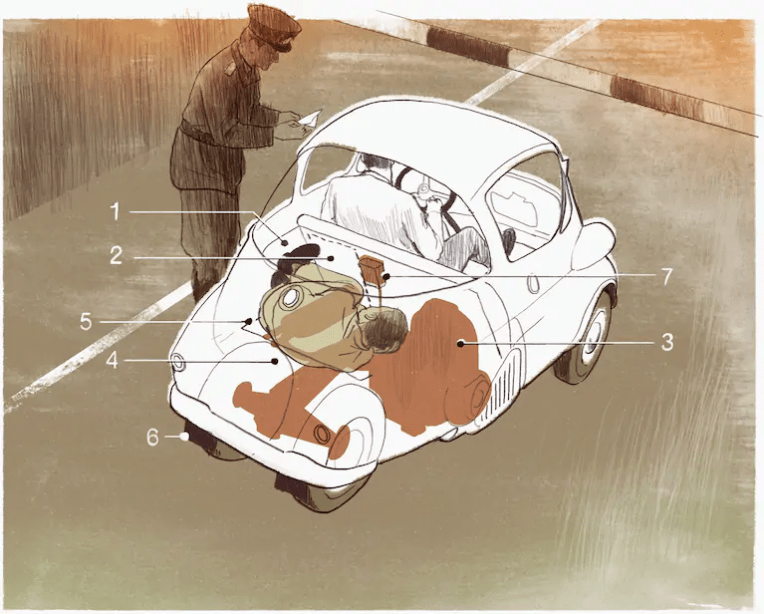
Risking imprisonment, torture and death, Klaus-Günter Jacobi modified a BMW Isetta to help his friend escape the oppression of East Germany in 1963. Nine others were able to escape using the same method.
[Escaping East Berlin in a 1961 BMW Isetta [via]. Short vid here.]
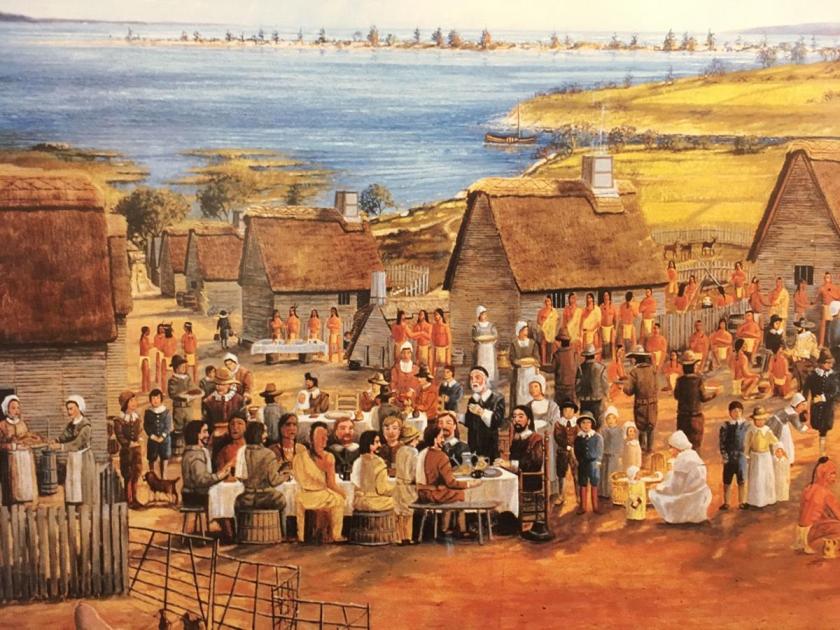
Nearly all of what historians have learned about the first Thanksgiving comes from a single eyewitness report: a letter written in December 1621 by Edward Winslow, one of the 100 or so people who sailed from England aboard the Mayflower in 1620 and founded Plymouth Colony in Massachusetts.
[…]
Just over 50 colonists are believed to have attended, including 22 men, four married women—including Edward Winslow’s wife—and more than 25 children and teenagers. These were the lucky ones who had made it through a rough entry into the New World, including a harsh winter during which an epidemic of disease swept through the colony, felling nearly half the original group. Some 78 percent of the women who had arrived on the Mayflower had died during the first winter, a far higher percentage than for men or children.
“For the English, [the first Thanksgiving] was also celebrating the fact that they had survived their first year here in New England,” Tom Begley [of Plymoth Plantation] points out.
The Plymouth colonists were likely outnumbered more than two-to-one at the event by their Native American guests. Winslow’s account records “many of the Indians coming amongst us, and amongst the rest their greatest king Massasoit, with some ninety men.” Massasoit (who was actually named Ousemequin) was the sachem (leader) of the Pokanoket Wampanoag, a local Native American society that had begun dealings with the colonists earlier in 1621.
[Image from here, historical commentary from here.
Related posts here.]
Veterans Day gives Americans the opportunity to celebrate the bravery and sacrifice of all U.S. veterans. However, many Americans confuse this holiday with Memorial Day.
A Brief History of Veterans Day
Veterans Day, formerly known as Armistice Day, was originally set as a U.S. legal holiday to honor the end of World War I, which officially took place on November 11, 1918. In legislation that was passed in 1938, November 11 was “dedicated to the cause of world peace and to be hereafter celebrated and known as ‘Armistice Day.'” As such, this new legal holiday honored World War I veterans.
In 1954, after having been through both World War II and the Korean War, the 83rd U.S. Congress — at the urging of the veterans service organizations — amended the Act of 1938 by striking out the word “Armistice” and inserting the word “Veterans.” With the approval of this legislation on June 1, 1954, Nov. 11 became a day to honor American veterans of all wars.
In 1968, the Uniform Holiday Act ensured three-day weekends for federal employees by celebrating four national holidays on Mondays: Washington’s Birthday, Memorial Day, Veterans Day, and Columbus Day. Under this bill, Veterans Day was moved to the fourth Monday of October. Many states did not agree with this decision and continued to celebrate the holiday on its original date. The first Veterans Day under the new law was observed with much confusion on Oct. 25, 1971.
Finally on September 20, 1975, President Gerald R. Ford signed a law which returned the annual observance of Veterans Day to its original date of Nov. 11, beginning in 1978. Since then, the Veterans Day holiday has been observed on Nov. 11.
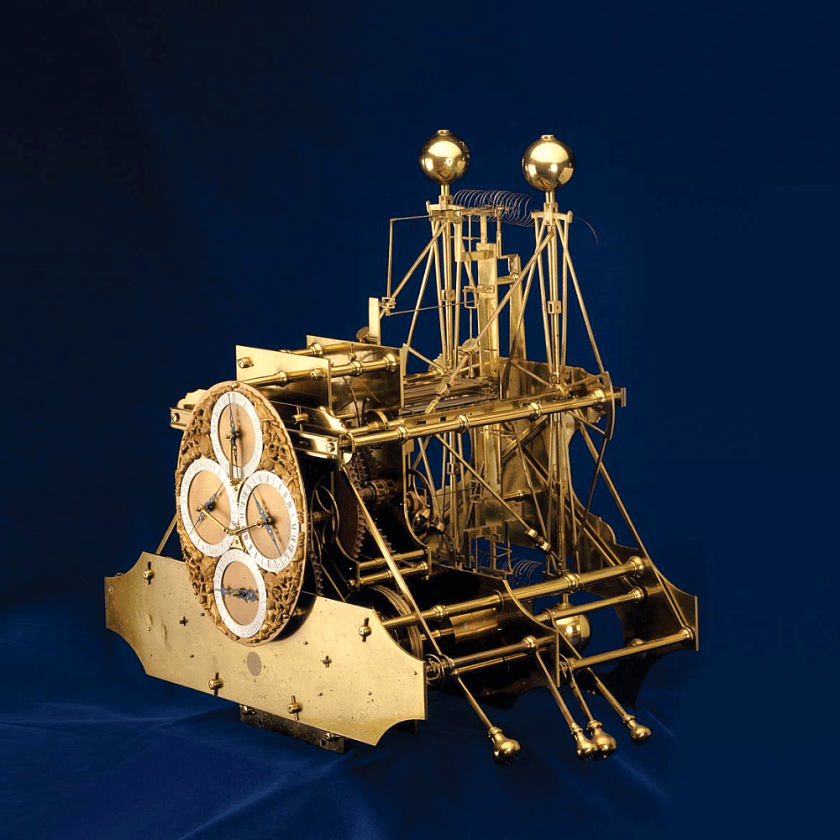
Self-taught John Harrison spent 43 years overcoming engineering challenges to develop the first marine chronometer. Harrison won a British competition to resolve deep sea navigation problems, but it took him several years to win the full prize.
In 1714, the British government offered a longitude prize for a method of determining longitude at sea, with the awards ranging from £10,000 to £20,000 (£2 million to £4 million in 2019 terms) depending on accuracy. John Harrison, a Yorkshire carpenter, submitted a project in 1730, and in 1735 completed a clock based on a pair of counter-oscillating weighted beams connected by springs whose motion was not influenced by gravity or the motion of a ship. His first two sea timepieces H1 and H2 (completed in 1741) used this system, but he realized that they had a fundamental sensitivity to centrifugal force, which meant that they could never be accurate enough at sea. Construction of his third machine, designated H3, in 1759 included novel circular balances and the invention of the bi-metallic strip and caged roller bearings, inventions which are still widely used. However, H3’s circular balances still proved too inaccurate and he eventually abandoned the large machines.
Harrison solved the precision problems with his much smaller H4 chronometer design in 1761. H4 looked much like a large five-inch (12 cm) diameter pocket watch. In 1761, Harrison submitted H4 for the £20,000 longitude prize. His design used a fast-beating balance wheel controlled by a temperature-compensated spiral spring. These features remained in use until stable electronic oscillators allowed very accurate portable timepieces to be made at affordable cost.
£20,000 in 1714 = ±£3,837,000 in 2018 = ±$4,733,000 USD.
$110k/year is not a bad payoff for a 45 year-long side project. Harrison began as a 21 year-old, and was 66 when he resolved the problem and received the full amount of the prize. He died 17 years later in 1776.
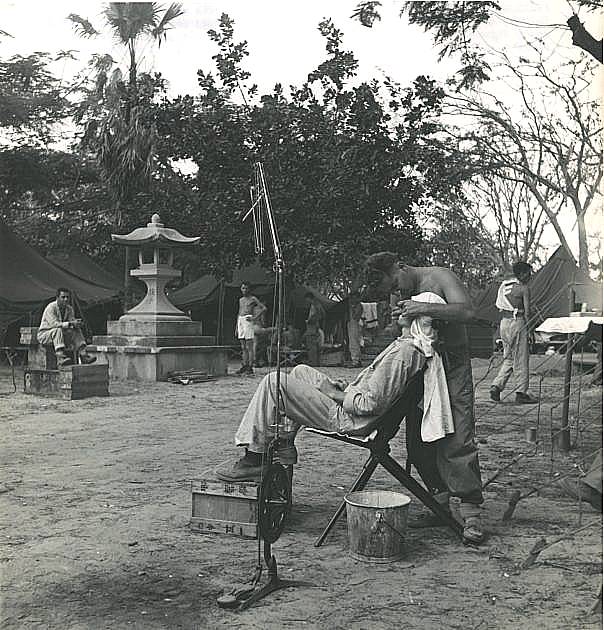
“A Marine dentist sets up his office on Saipan, using a Japanese box as a footrest, a Japanese pail as a waste-bucket, and a Japanese shrine (left background) as decor for his waiting room. In order to keep his dentistry really ‘painless’ a Marine patrol nearby kept on the alert for Jap snipers.” (U.S. Naval Institute Photo Archives)
[Caption and image found here. Story at the link.]

“In the mid twentieth century there was made a series of photographs advertising Soviet “An” planes to western buyers. Some of these photos have been revealed just recently. Party leaders didn’t allow them to be used abroad and the photos were kept in the archives of “Antonov” company.”
[Image and caption found in here. More about the Ukraine-based company here.]