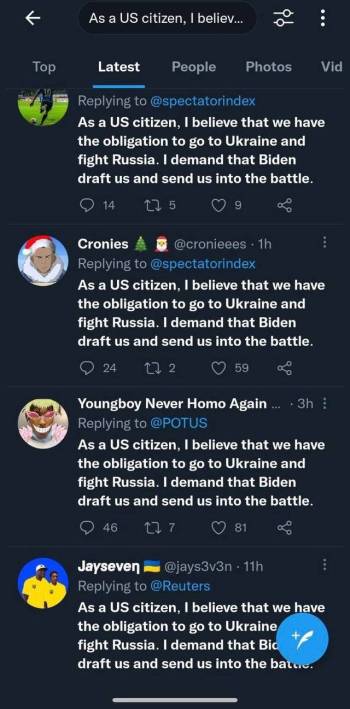
Bots wanna bot: As a US citizen, I believe that we have 85 Jessicas

Jessica sure gets around. More AstroturfBots here and here.

Update: Forgot this:

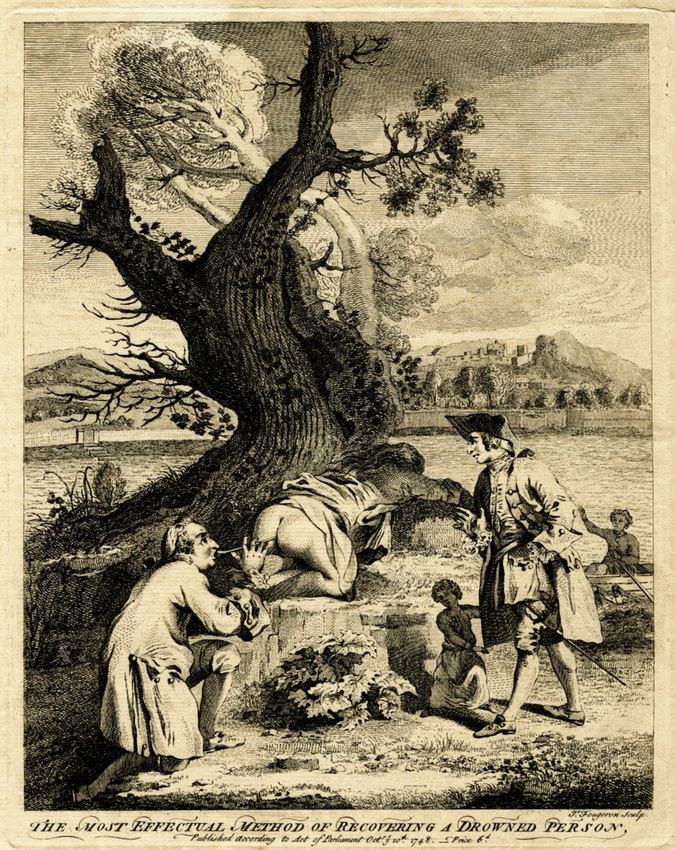
The Most Effectual Method of Recovering a Drowned Person

The Most Effectual Method of Recovering a Drowned Person, a print made by John Fougeron, satirising the French technique, 1747

In the 1730s, René Antoine Ferchault de Réaumur popularized a recent discovery: the seemingly lifeless could be revived with a wealth of strategies. This “Pliny of the Eighteenth Century” (Réaumur invented a precursor to the Celsius scale, influenced methods of silk production in China, and pioneered the process of metallic tinning still used today) wrote a pamphlet titled Avis pour donner du secours à ceux que l’on croit noyez (Advice to aid those believed drowned).

After debating the pros and cons of tickling the nose with feathers and filling a drowning man’s mouth with warm urine, Réaumur reveals what he believes to be the best technique: using a pipe stem to blow stimulating tobacco smoke into the intestines through the rectum. Louis XV found the pamphlet dazzling and encouraged its wide distribution. Startlingly, as Anton Serdeczny discusses in his recent book on reanimation, soon riverbanks across Europe were lined with “resuscitation kits”, as close-by as a contemporary defibrillator, which contained all the necessary supplies for giving a nicotine enema (and later, thankfully, included bellows as a substitute for breath).

[Source.]

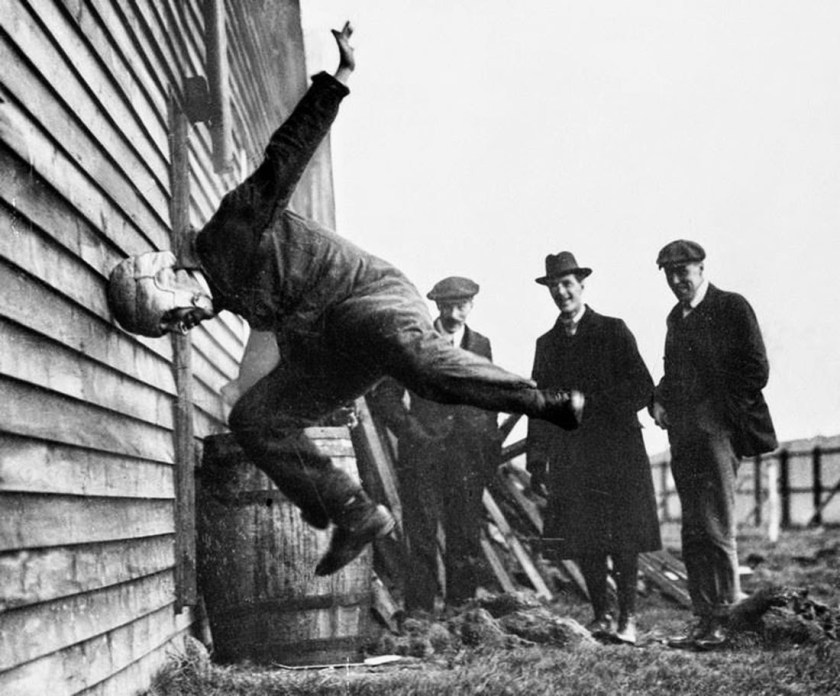
Helmet Testing 1912 – W. T. Warren’s Contribution To The World

“This rather comical photo was taken in 1912, and contrary to popular belief on the internet it isn’t a man testing a new prototype of American Football helmet by bashing his head against a wall. The truth is actually more interesting than the myth when it comes to this image. In actual fact the man is British inventor W.T. Warren, and the image is of him leaping against a hanger wall at the flying school of William Hugh Ewen, at Hendon in the UK.

His invention, the Warren Safety Helmet was a spring-equipped pilot safety helmet, which was padded with horsehair. It was designed to absorb an impact as head injuries were the leading cause of death in flight accidents at the time. The helmet saw considerable use during World War I and an example of Warren’s invention can be found in the Imperial War Museum.

The other men in the photo are the flying school’s owner William Hugh Ewen, in the middle, on the left stands his chief pilot Lewis Turner and the man on the right was named A. M. Ramsey. The photograph was published in Aviation magazine Flight on 6th April 1912.”

[Image found here, description from the comments.]

Sao Paolo Political Pantsing 2016

Sao Paolo, Brazil,  2016.

Story in Portuguese here. Google Translate here.

Prophetic Street Art From 2014

Street art by Chemis, Benesov, Czech Republic, 2014.

Humming Brrrr

“On Jan. 27, 2021, water melted off of Tammy Shriver’s rooftop in Bangor, dripped onto the tree branches below, then refroze in the shape of a hummingbird.”

“A little bit of sunshine that day melted the hummingbird somewhat, transforming it into a different bird.”

[Story here, h/t Pam M.]

My WebEx Meeting Notes 22 November 2021 – 12 January 2022

9AM daily. Pen on paper, 8-1/2 x 11, approx. 3 square inches per day.

I’m really not schizophrenic, and neither am I. We just like to doodle.

January Sixth

CapitolPunishmentTheMovie.com

You Are Here. Or Not.

Uranium Atom’s Tightly Clustered Core Is the Main Source of Atomic Energy
Shown in Boston’s Museum of Science, this model depicts radioactive uranium 235, whose nucleus contains 92 protons and 143 neutrons. Nonfissionable uranium 238 carries three additional neutrons. Both are isotopes, or variants, of Nature’s heaviest element. Balls bunched in the center represent the protons and neutrons, which are mysteriously bound together by atomic energy’s terrific force. Splitting of the nucleus releases energy far greater than that of any chemical reaction. Wire-strung balls swinging like planets around a sun represent uranium’s 92 electrons. Hydrogen, in contrast, has one. True scale would place the outermost electrons 3,000 from the center.

[Image ca. 1954, with caption, found here via here.]

1955 Tighty Whities

“In 1955, Jockey Briefs ran an ad campaign featuring young boys shoving guns into their underwear.  The image on the left is via vintageskivvies.com, who says that it ran in Woman’s Home Companion; the one on the right is from eBay.” Posted By: Alex – Sun Oct 13, 2013

I spotted the ad on the left somewhere recently, thought it had to be a photoshop due to recent events. Nope. It’s legit, and there were no riots at Kenosha Elementary on that day.

[Images and caption found here. The link in the caption is dead, but I left it as I found it.]