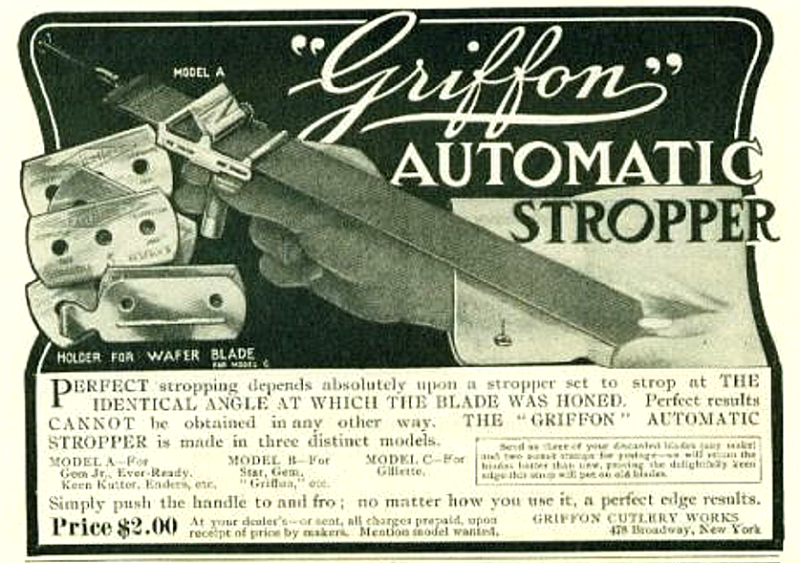
Both my grampas had stroppers in their bathrooms, and they weren’t used for disposable blades. They used straight razors with a cup of hard shaving cream and a brush. Put a little water in the cup, brush up a lather, then pay attention.
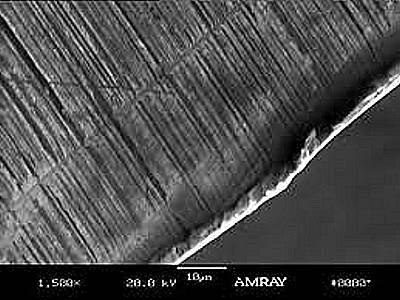
For those of you who grew up later than I did, the strop was a strip of leather hanging by a ring adjacent to the barber’s chair. Barbershops still had them when I was a kid, and they were used to get rid of a used blade’s microscopic burl:
Pushing hay [via]. Makes me itchy just watching it.
“The Ballad of Holland House” is based upon a true story.
Holland Island sits in Chesapeake Bay, near Wenona, Maryland. The five-mile-long island was settled in the 1600s, and at one time had a population of 360 people and 70 buildings. Erosion ate away at the island, which sat on silt and clay, and the residents moved away between 1914 and 1918. The island’s church was moved in 1922, and only one house remained standing. It was built in 1888. For decades, the water ate away at the island, and the last remaining house finally collapsed in October of 2010. What’s left of the island is now a marsh, home to hundreds of sea birds. See pictures of the island and the house -and the cemetery- at the Baltimore Sun[via].
Here’s another onefrom 1978, called “the first postmodern ruin.” I visited the latter ten years after construction and it was a crumbling bio-hazard with human feces in the dry pools.
The Spelling Nazi Reports:
“We hold these truths to be self-evident, that all men are created equal, that they are endowed by their Creator with certain inalienable Rights, that among these are Life, Liberty and the pursuit of Happiness.”
I’m guessing they’re wooden, and some appear to be from the 1920s, perhaps earlier.
I don’t know a lot about hats, except that early makers of felt hats used mercury in the process, and the accumulation of that metal in their systems eventually affected their mental stability, resulting in the phrase “Mad as a hatter.”
Originally, cowboy hats and others were functional rather than a fashion statement. Brims were flat, designed to shade the sun and drain the rain, but once movies came about, the sides of the brims were turned up to show the actor’s faces. I suppose the crease in the top kept water from flowing off the sides and toward the back.
The side “dent” is a mystery, unless it was where a man grabbed it just before saying,
“Well, helloooo, ladies.”