


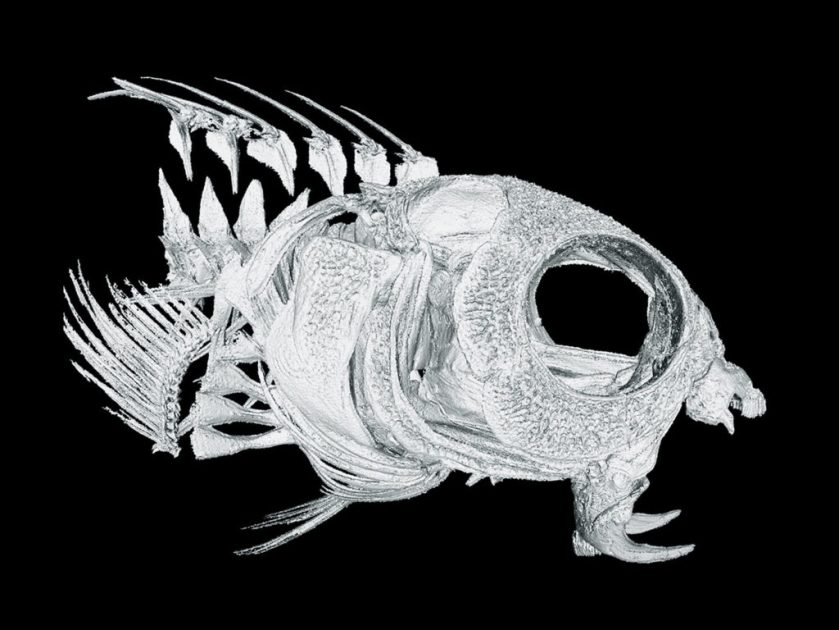
I presume that’s the skull of a fang blennie, and one species injects an opioid venom to mess with their predators’ brains.
The fang blennies have, generally speaking, evolved into rascals. Their ancestor probably used its fangs to scoop flesh out of bigger fish, much like the non-venomous bluestriped fang blenny does today. It’s a visual mimic of a cleaner fish, which allows it to get in close without raising an alarm. Then it strikes. “A total asshole move, of course, since that bigger fish is going to take this out on the next innocent cleaner wrasse it encounters,” says biologist and study co-author Bryan Fry of the University of Queensland.

[Found on a small cutting board in our kitchen.]

ATLANTIC OCEAN (April 15, 2015) The guided-missile destroyer USS Porter (DDG 78) pulls alongside the Military Sealift Command dry cargo and ammunition ship USNS Medgar Evers (T-AKE 13) before a replenishment-at-sea. Porter is participating in Joint Warrior, a United-Kingdom led training exercise designed to provide NATO and allied forces with a unique multi-warfare environment in which to prepare for global operations. (U.S. Navy photo by Rohn D. Wallace/Released)
There’s an interesting timeline posted at USNI regarding the missile attack on the Syrian military airbase on 6 April 2017 that I haven’t seen elsewhere, and it gives hints about the strategy behind it… and more.
[Image and caption found here. USNI is updating their post as more information is released.]

Mark Twain’s study was designed to simulate the pilot house of a Mississippi steamboat.
Rogue Punctuation Nazi strikes after-hours in Bristol, England. He specializes in fixing apostrophe errors on business signs.
Need a Computer Science paper at the last minute? This generator is for you.
I knew that rebooting and hitting F8 gets you into safe mode for trouble shooting. Here’s what the other keyboard function keys do.
“The Frog Survey Letter” went viral a couple years ago.
Never heard of Hooverball? Now you have.
Click “play.”
Like early jazz? You’ll love this free download of 1920s recordings. It’s six hours of syncopated awesome.
[Top image found here.]
Very odd video. I like it.
Elvin Bishop goes fishin’. Guy has an amazing history, and I’m surprised he isn’t a full-fledged Rock God by now. His website www.elvinbishopmusic.com is back up and running.
We lost another great bluesman recently:
Lee Baker, Jr., aka Lonnie Brooks (1933-2017).
Lonnie Brooks was another classic bluesman with an interesting background.
Have a great weekend, folks. We’ll be back here tomorrow, whether you like it or not.

[Found here.]
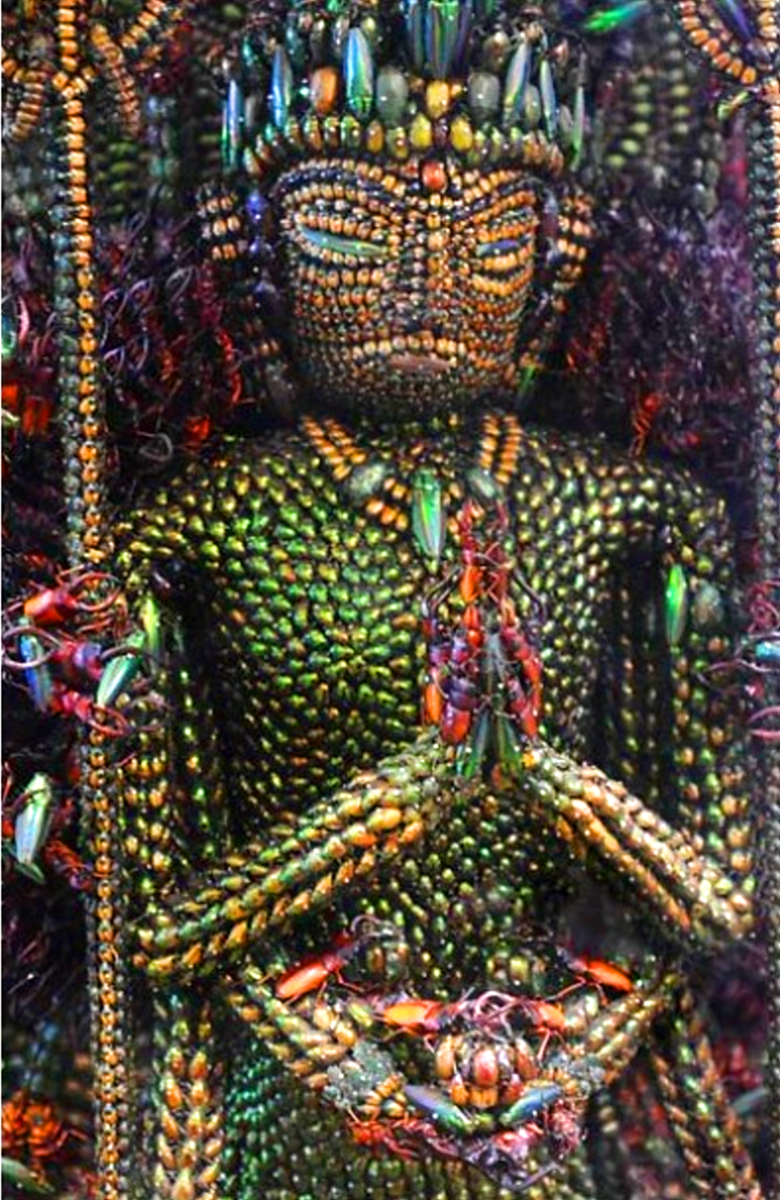


Although [Yoneji] Inamura created several sculptures out of beetles, he spent 6 years in the 1970s constructing this one, which has become his masterpiece and the largest sculpture he ever made. When it was done he donated it to the city.
The sculpture, made from rhinoceros beetles, winged jewel beetles, drone beetles, longhorn beetles and other types of local beetles, depicts the senju kannon bosatsu (1000-armed bodhisattva), a popular Buddhist deity in Japan.
[Click on the smaller images to enlarge. More here, found here. Somewhat related posts here.]