

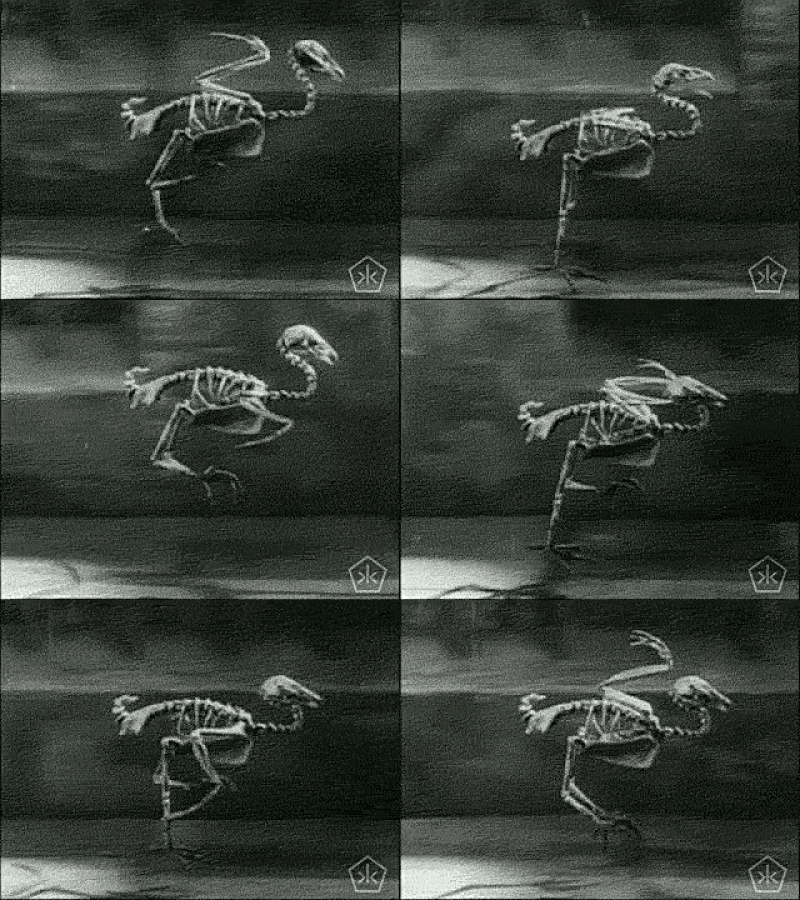
[Found here, here and here. Goosewalker h/t Gord S.]
UPDATE: Duck skeleton was likely from a 1933 animation The Mascot / The Devils Ball. Again, h/t Gord S.


The Picasso of circus art.
Fred G. Johnson’s (1892 – 1990) banners were used to illustrate A Century of Progress for the 1933 Chicago World’s Fair His artwork also advertised the Ringling Brothers, Barnum & Bailey and Clyde Beatty circuses.
Hired by banner painter Harry Carlton Cummins to clean equipment and stick up banners, Cummins taught Johnson how to paint them, which he did, producing as many as four a day. The art is fast, subjective and made to deadline.
Not to be confused with the great Fred Johnson, bass singer for The Marcels.
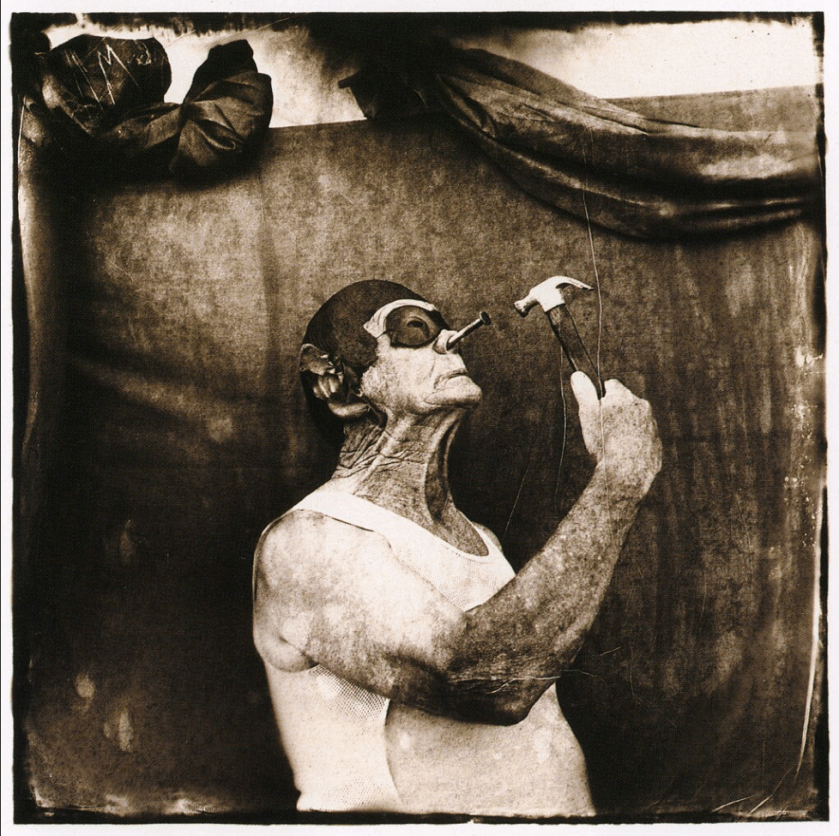
It’s kind of disgusting, but here’s How the Human Blockhead Trick Works.
Image captured by American photographer Joel-Peter Witkin.
Much of his work is twisted and creepy, presumably due to what he witnessed as a child, and NSFK. You’ve been warned.
[Found here.]
My Good Pott, Doc Pomus & Curley Russell’s All Stars (1948)
Jerome Felder, better known as Doc Pomus, was one of the grandfathers of rock and roll. He wrote and performed rhythm & blues, a genre that belonged almost exclusively to black American artists whose 78s were often categorized as “race records.”
“By the late 1950’s he was established as one of the best songwriters in the business which is where he’d make his name and cement his legend. During that time it’s doubtful anyone buying his classic compositions performed by The Drifters, Dion & The Belmonts, Ray Charles and the ultimate white-Negro Elvis Presley, were even aware Pomus once sung this kind of music before any of those artists had even cut their first record.”
Spontaneous Lunacy – The History of Rock ‘N’ Roll – Song By Song
Another of Pomus’ contemporaries broke the R&B color barrier soon after: Ioannis Alexandres Veliotes, aka Johnny Otis.
“Doin’ dishes?”
Blowing up Stretch Armstrong.
[via Memo Of The Air]
Over 12,000 phone calls so far this year.
[via The VFLL]
Places to go: The best museum restrooms.
[via Mme. Jujujive]
#BadStockPhotosOfMyJob. (More on The Twitter.)
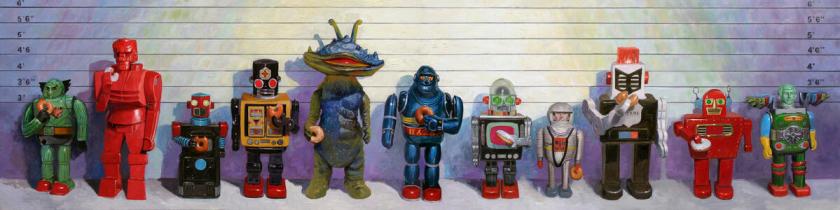
[Top image: Robot lineup found here.]
From the Archives: 1 year ago. 5 years ago. 10 years ago.


[Images from Life Magazine (November 1948) found here. Related posts here.]
Violent Love, The Big Three Trio (1951) Okeh Records Active from 1946-1952, The Big Three Trio consisted of Leonard “Baby Doo” Caston (piano, vocals), Ollie Crawford (guitar, vocals) and Willie Dixon (upright bass, vocals). Dixon wrote this and many other blues standards during his lengthy career. (Note: Crawford replaced band founder and guitarist Bernardo Dennis in 1947.)
Root cellars [via Mme. Jujujive].
EV charging stations in California.
Economic forecast [via Bunkerville].
Violent Love, Oingo Boingo, live 1983.
Sea Matheson at Fat Studies Conference.
There’s a hole in the port plate, dear Liza.
Freespoke is another search engine alternative to Google. (I haven’t checked it out yet – I use DDG.)
[Top image found at Tfarhad.]
From the Archives: 1 year ago. 5 years ago. 10 years ago.

[Found here.]


[Found around the internest, but I misplaced the sources.]




 Tacky Raccoons