




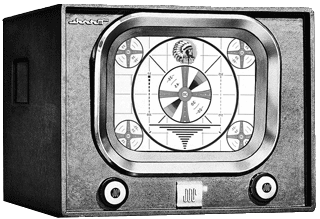
[Found here.]
Nothing Much Happened Today.
[Found here.]
[Found here.]
Human produced CO2 is responsible for everything. Lol.
Interesting concept: an online collaborative to write stories with multiple authors in real time.
How to make a very cool simple electric train.
Fun facts to know and tell:
Bears’ closest living relatives are pinnipeds (seals, sea lions and walruses).
Pinnipeds’ closest living relatives are bears and musteloids (skunks, weasels and raccoons).
The German word for “raccoon” is Waschbär, which translates literally to “Wash Bear.”
Here’s a naked bear. Here’s a naked raccoon.
Viral video by Russel Houghton – Urban Isolation. L.A. without traffic.
Why is The Parkside Inn Motel (Bundoora, Australia) ranked No.1? Because there’s no No. 2. Interesting reviews. [via]
This is possibly The Greatest DooWop song ever recorded, by The Channels.
Your Telephone Of Tomorrow: Fairly accurate prediction from September 1956, and source of the *ahem* top image.
P.S. We get notifications of new followers from time to time, and we like to see who you are, so we stop by your blogs out of curiosity. Our readers are an eclectic mix of all ages, backgrounds, ethnicities and nationalities. We’ve known this for years, courtesy of WordPress, RevolverMaps and other sources.
That said, here’s the website of a recent follower, both disturbing and fascinating at the same time. NSFK except as a warning to those who choose to tread a similar path.
–Bunk
Here’s a description of Lee Morse [via]:
“She was 5 feet tall. She was less than 100 lbs “soaking wet”. She spent her childhood in Oregon and Idaho yet was proud of her family’s Southern roots. She could hunt and fish and, if you deserved it, she could punch your lights out! She was Lee Morse, one of the most popular female recording artists during the Jazz Age 20’s and 30’s. And, she is worth remembering.” ~Ian House
Doc Watson, David “Dawg” Grisman and Jack Lawrence live in 1995. Lawrence was the late Watson’s accompianist for many years.
“My Blue Eyed Jane” was written by Lulu Belle White and Jimmie Rogers, first recorded by Jimmy Rogers with Bob Sawyer’s Jazz Band in 1930.
Jimmie Rogers (1897-1933) is considered the Father of Country Music for his long-lasting music influences, worked the railroad until he contracted tuberculosis in 1925. While fighting off the disease and unable to perform physical labor, he returned to his original love, writing and performing, until he succumbed at the age of 35.
Sadly, there was a vaccine to combat TB as early as 1921, but according to Wiki it wasn’t widely available in the U.S. or Europe until after WWII. Rogers also sang about his affliction in “TB Blues.”
Here’s Jimmie Rogers in the Columbia Pictures short “The Singing Brakeman” from 1930.
That’s it for this edition of The Saturday Matinee. Have a great weekend, folks.
“Pogo” was penned by a famous anti-communist conservative cartoonist and his missive was directed at the Southern Democrats who created the KKK and enforced segregation via Jim Crow Laws. Walt Kelly was often occasionally censored by the liberal media some newspapers for posting strips like these, so he published his uncensored opinions in “The Pogo Poop Book” in 1966.
We need more people like Walt Kelly to fight the latest “Gibber of Goblins,” and these New Goblins don’t wear white hoods either…
[Update: Some wording has been amended by popular demand.]

There’s a bizarre history to that familiar song credited to The McCoys, and it traces to Dorothy Sloop of Steubenville Ohio who became a New Orleans singer and piano player with the stage name “Sloopy.” The song was originally recorded by The Vibrations in 1963, predating the McCoys’ version:
So how did a 60s soul group from LA decide to sing about a girl who moved to New Orleans?
“Sloopy” was Dorothy Sloop, a Bourbon Street piano player. Born Sept. 26, 1913, in Steubenville, she performed at a New Orleans nightspot under the stage name Sloopy.
‘Hang on Sloopy’ was written by Bert Russell Berns and Wes Farrell, two New York City songwriters. Berns also wrote The Isley Brothers and Beatles hit Twist and Shout. Farrell went on to become the musical brains behind the Partridge Family.
The song was originally recorded as My Girl Sloopy by the Los Angeles R&B vocal group the Vibrations. It debuted in April 1964 in the Top 40 of the Billboard pop chart, where it spent five weeks and reached No. 26.
A rock version, ‘Hang on Sloopy,’ was recorded by the McCoys, a Dayton garage band led by Celina native Rick Zehringer. Locally, the band was known as Rick and the Raiders, but it changed its name to avoid confusion with chart-toppers Paul Revere and the Raiders. Hang On Sloopy debuted in September 1965 in the Top 40 of the Billboard pop chart, where it spent 11 weeks and reached No. 1.
Rick Zehringer later changed his name to Rick Derringer and became one of the top rock guitarists and producers of the 1970s. He recorded with the Edgar Winter Group and scored a 1974 solo hit with Rock and Roll, Hootchie Koo. [More at this source]

“Dixie” Fasnacht operated a bar called Dixie’s Bar of Music on Bourbon Street in New Orleans. It was there that Dorothy’s acquaintance and co-writer of “Hang On Sloopy” Bert Berns-Russell found the inspiration for the song. During problems with the sound equipment and a crowd getting rowdy, he heard a regular call out to her “Hang on, Sloopy!” [Source]
I couldn’t find a recording of either Dottie Sloop or Yvonne “Dixie” Fasnacht, but there has to be a copy of the album in someone’s basement somewhere. One more piece of trivia: Ohio is the only State to have an Official State Rock Song.
The Best Damn Band In The Land adopted “Hang On Sloopy” as a signature song for the times when OSU was down a few points, and their a capella version is classic.
Have a great holiday weekend, folks.
Here’s Dave Brubeck‘s partially discordant cool jazz classic “Take Five” in 5/4 time (also known as quintuple time, i.e, five beats per measure, quarter note gets the beat: 1-2-3-1-2, 1-2-3-1-2, etc.). Here’s an interesting take:
Sachal Studios, Lahore, Pakistan, with sitar and that boingy drum thingy.
Another famous song in 5/4 is Lalo Schifrin‘s “The Theme To Mission Impossible.” Here’s a bizarre version that wavers between 5/4 and 4/4, by Kua Etnika.
Sting‘s “Seven Days” is in 5/4, too, as if you cared, and Zappa’s former drummer Vinnie Colaiuta explains it here.
Ginger Baker’s Air Force also cranked 5/4 in 1970 with “Do What You Like,” and it included a self-indulgent in-your-face mandatory drum solo (dissected by Marky Ramone).
That should hold you for a tad. Have a great weekend folks, and we’ll be back in a jiffy.
[Found here.]
A happy dog in a pile of leaves [via].
What a hurricane sounds like: Hurricane Ike 2008 [via].
“Hey, yinz. Stillers ain’t jagoffs. We gotcha tear-bull talls, yah.” This long linguistic analysis of Pittsburghese is missing one thing: audio examples of the dialect [via].
It’s also come to my attention that the Pittsburgh “yinzer” accent was voted the most annoying dialect in the Nation, and I disagree. The New York accent that pronounces the word “all” as “ohl” is worse than the Southern California accent (made famous in Zappa’s “Valley Girl“) that inflects statements into questions?
Robert Goddard’s 1914 Patent for a liquid-fueled rocket. Consider that in 1914 we barely knew how to design airplanes. In those days, the fuel gauge was a pocket watch hung on a nail.
[Top image from here.]