Just a few days left before I have to begin Christmas shopping so posting here may be sporadic. Have a great Pre-Christmas weekend, folks. Be back here tomorrow for stuff.
This is what happens when you ask a bunch of little kids to tell the story of Christmas with adult cameo actors. [Found here. Those below were found by U-Toobage association, and they’re entirely awesome..]
May God bless the innocents.
I wonder what would happen if you asked a bunch of grown-ups…
Nice amateur work: “Four years ago I set out to make a short film with my two boys and an iPhone. It’s done now. We hope you like it.” The background story is pretty cool, too [via].
Talent Night: Be patient with this one. The kid’s good, and I bet he’s a fan of PDQ Bach.
How ’bout some Speedgrass?
Fast pickin’ by a band with a great name: Trampled By Turtles. They have to change their strings each time they play that one.
Okay, so where do we go from here? Oh wait. I know.
How ’bout some British shopping mall piano boogie-woogie?
I don’t know who those two are, but they appear on several videos at the same location.
Have a great weekend, folks, see you back here in the wee hours. Or later.
The “music” is irritating as hell, but with the videos it becomes awesome. If I embedded it correctly, it should play 13 short clips in sequence, and you can jump to the next one if you wish.
[Found via here.]
Old radio shows used similar sound effect techniques.
“Radio is the theater of the mind; television is the theater of the mindless.” – Steve Allen
Also note that the vid was a GM-sponsored short, so the good guys catch the bad guys in the end because the good guys are in a Chevrolet and the bad guys are only on horses.
“Rarg is a land so perfect that the sun never rises until it is absolutely sure that everyone is awake. It is a wonderful place where everyone loves learning and making new discoveries. Until one day, an astonishing discovery is made… a discovery that might just be a problem.”
So where do we go from here? Oh, hell. I know: a sappy cover of Santo & Johnny.
Buzzchopper‘s other stuff sounds like Surf Ramones to me, and they opened for Mink Stole in Harrisburg, Pennsylvania, 2010. Last time I passed through Harrisburg, you couldn’t buy beer or wine in a convenience store or in a supermarket, and that means that something’s seriously wrong with that place.
To all our frozen friends back east, awesome happens at about 1:00.
Have a great weekend, folks, and be back here for leftovers.
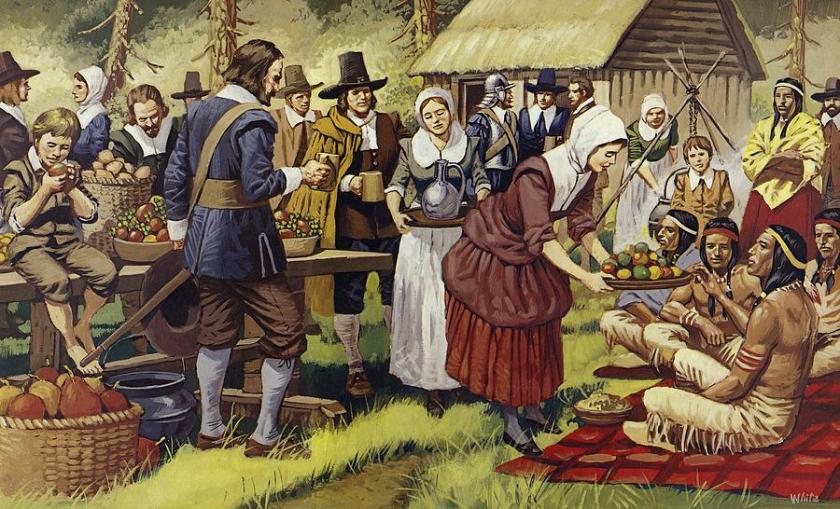
Food, football, and…oppression. That’s what Thanksgiving has come to mean to many Americans. Back in 2007, Seattle public school officials made national news by describing the holiday as a “time of mourning” and a “bitter reminder of 500 years of betrayal.” This new narrative describes the Pilgrims as arrogant oppressors who fled persecution only to become persecutors themselves, depriving Native Americans of their land and their lives. But this is wrong on every count.
Should Americans celebrate Thanksgiving as a day of gratitude? Or should they mourn it as a day of guilt? Michael Medved, author of The American Miracle, shares the fascinating story of the first Thanksgiving.
In 1932, Franklin Roosevelt ran against incumbent President Herbert Hoover for the presidency, hence the caricatures, and there are hints about the repeal of Prohibition in this cartoon. Hoover first shows up at 0:45. “Mr. Nobody” (1:12) probably refers to the other six candidates, including 3rd runner-up Socialist Party candidate Norman Thomas. Roosevelt’s nose and chin appear at 2:12.
The depiction of Congress at 2:28 is relevant today (as is Betty Boop twerking, promising everything for free). [Video found via here.]
Yep. That’s Penn Gillette (of Penn & Teller) on bass ca 1991. I first saw it in a movie theater as part of “Animation Celebration” or something, but I couldn’t find a link.
Clarence Gatemouth Brown (1924-2005) didn’t use a pick, and his calluses were tougher than woodpecker lips. Here’s his take on Bill Doggett‘s classic 1956 hit “Honky Tonk.” Brown was a speed blues artist as well. (If you doubt me, check out “Pressure Cooker.“)
RIP Roy Clark (1922-2018) What a great musical talent.
See you back here tomorrow for more extraneous arbitrary extrapolations.
Pray for those who lost loved ones, homes and businesses in the California fires, and don’t fall for the soulless scammers asking for donations. Donate directly to trusted charities only.
Awesome lineup, that. Recorded on August 27, 1974 at KCET in Hollywood, California.
Frank Zappa—guitar, percussion, vocals;
George Duke—keyboards, finger cymbals, tambourine, vocals;
Napoleon Murphy Brock—sax, vocals;
Ruth Underwood—percussion;
Tom Fowler—bass;
Chester Thompson—drums.
Awesome lineup, that. Recorded circa 1989
The Tonight Show Band Snooky Young – Trumpet
[That excellent video was sent down the memory hole just days ago for some unknown reason. What black-hearted soul would do such a thing? Let’s do this instead.]
Awesome lineup, that. Recorded circa 2010. The Tom Stormy Trio featuring Rhythm Sophie
Sophie – vocals
Tom Stormy – drums
Gábor Kiss – guitar
Buddy Benkey – double bass
Have a great weekend, folks. See you back here tomorrow and we’ll do stuff.
Stop-motion pumpkin carving is awesome. Many gourds sacrificed their lives [via].
“If you steal the kill, and nobody is hurt, that’s when you can relax.”
Hunting without killing is ballsy as all get out. Psych out the predators and steal their stuff before they figure out what’s going on and they kill you [via].
The Growlers is an excellent name for an excellent semi-retro band. I love ’em.
Bite The Buffalo is an excellent name for an excellent semi-retro band. I love ’em.
Have a great weekend, folks, and we’ll do something different tomorrow. Or not.
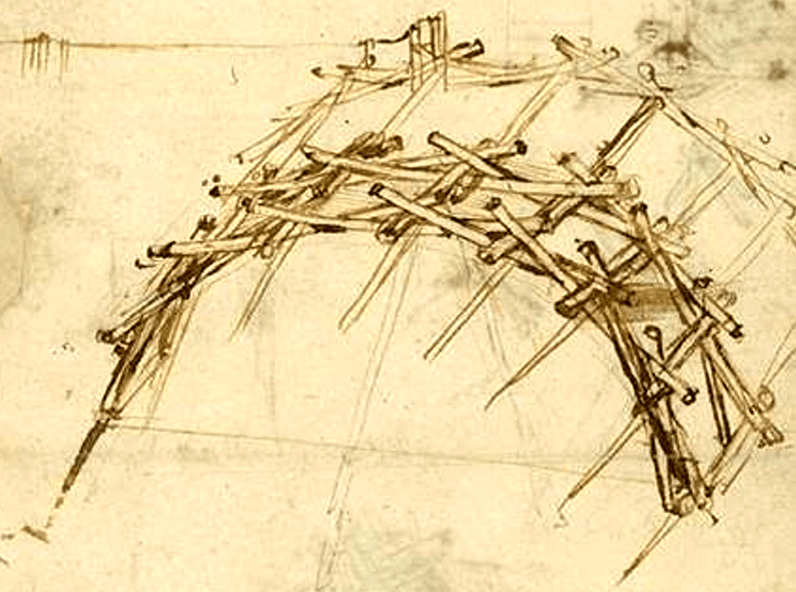
Okay 1502 AD is technically the 16th Century, but the engineering was already in existence.
VERY cool – You can build it on the spot if there’s available timber, no connectors required, and you can knock it down and take it with you once your army has crossed the stream, arroyo, ravine or ditch. Here’s one in use (with planks installed):
This kid constructed one without notches or connectors, using friction and compression only.
[Top image from Da Vinci. 2nd image from here, video from here, links found in here.]