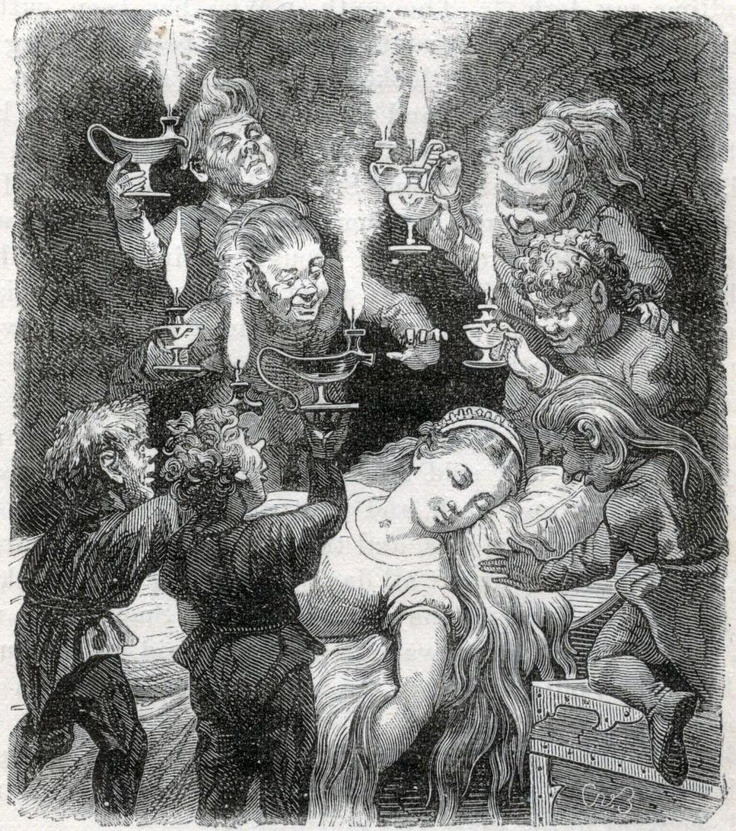
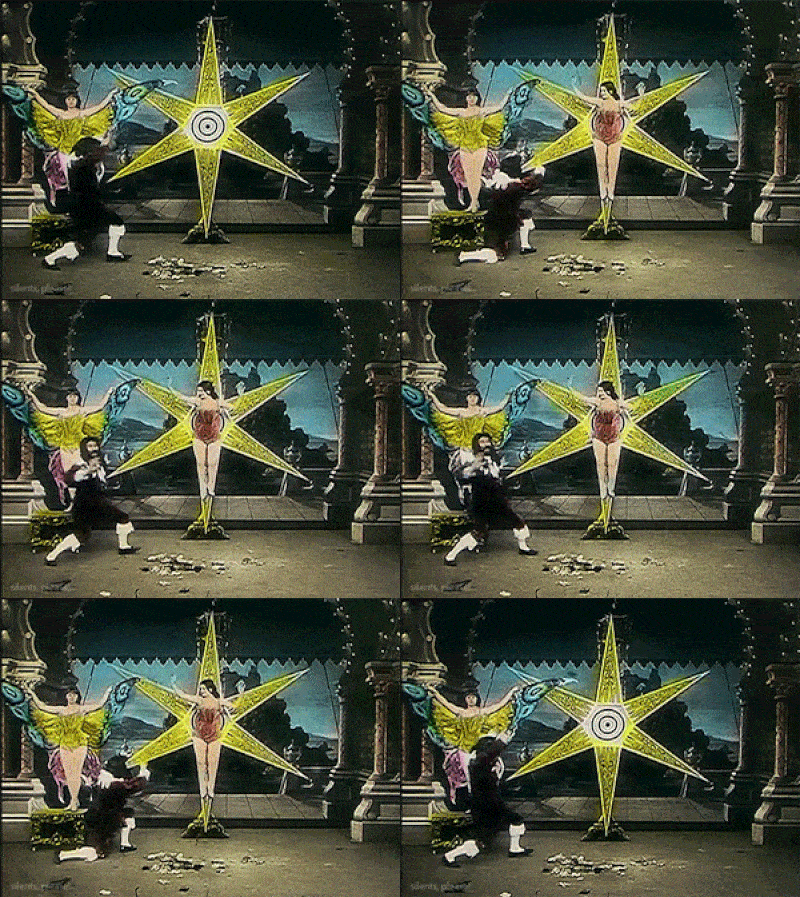
Identify them all. Hint: Snow White is the one pretending to be asleep.
[Found here.]

Identify them all. Hint: Snow White is the one pretending to be asleep.
[Found here.]
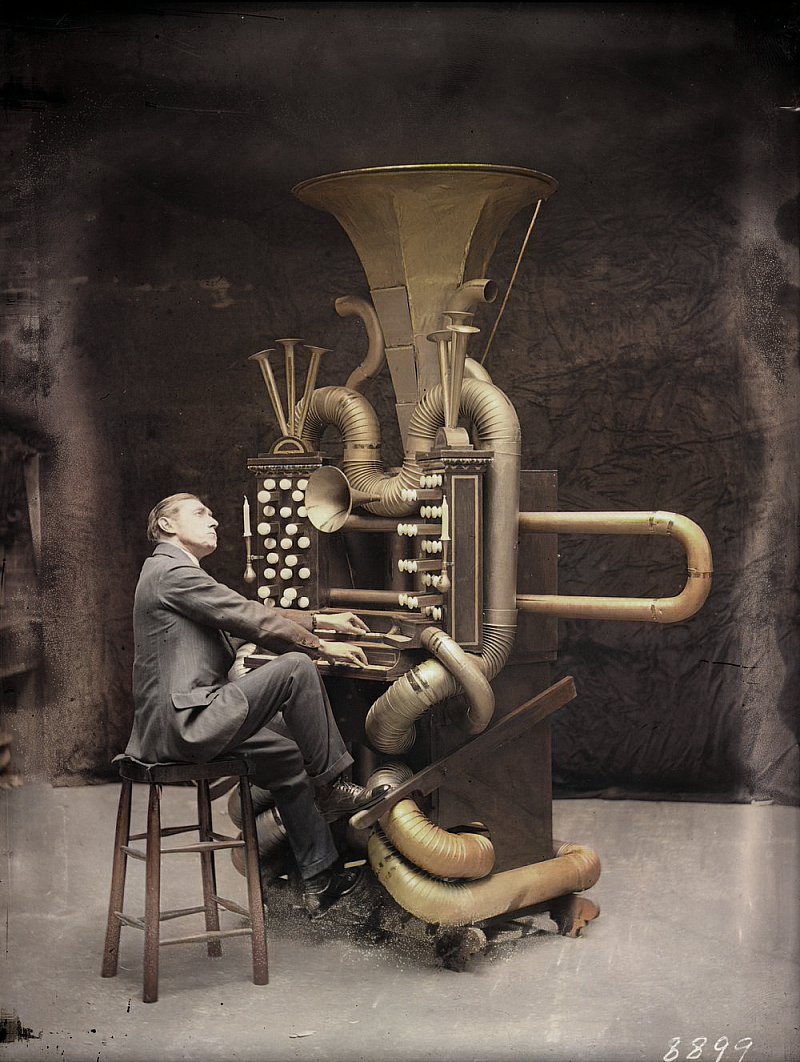
The Follyphone appeared on stage in London during the fall of 1912 during orchestral concerts conducted by H.G. Pelissier. And all of the newspaper accounts from the time make it sound like an interesting prop to deliver a message about anticipation, elaborate planning, and ultimately disappointment.
[Image and more about the Follyphone found here.]

[Found here.]
Swinging Mama, Tiny Grimes (1974)
Guitarist Lloyd “Tiny” Grimes (1916-1989) played with many jazz notables. In the late 1940s he had a hit on a jazzed-up version of Loch Lomond with the band billed as Tiny “Mac” Grimes and the Rocking Highlanders. They wore kilts and included Red Prysock on tenor sax and singer Screaming Jay Hawkins.
A common murre [via Bunkerville].
Sprinkle Lemon Happy Guy Muffins.
The Brennan Monorail [via The Feral Irishman].
The Mad Gasser of Mattoon [via Memo Of The Air].
Electro Queens and Digital Divas [via Everlasting Blört].
[Top image found here.]
From the Archives: 1 year ago. 5 years ago. 10 years ago. 15 years ago.




“Nobody outside his family knew his real name. Dallas knew him as Honest Joe. For nearly three decades Honest Joe’s pawn shop was one of the central hubs of activity in Deep Ellum. He sold everything from gold watches to prosthetic limbs to automatic weapons. His two-story building was covered in hand-painted signs and hubcaps – or was it? It was covered in signage and hubcaps, but as for the two-story part . . . well, that’s another story . . .”
[Top photo by Thomas Hoepker (1963) found here. Second photo found here (with a must-read history); third here; fourth here.]
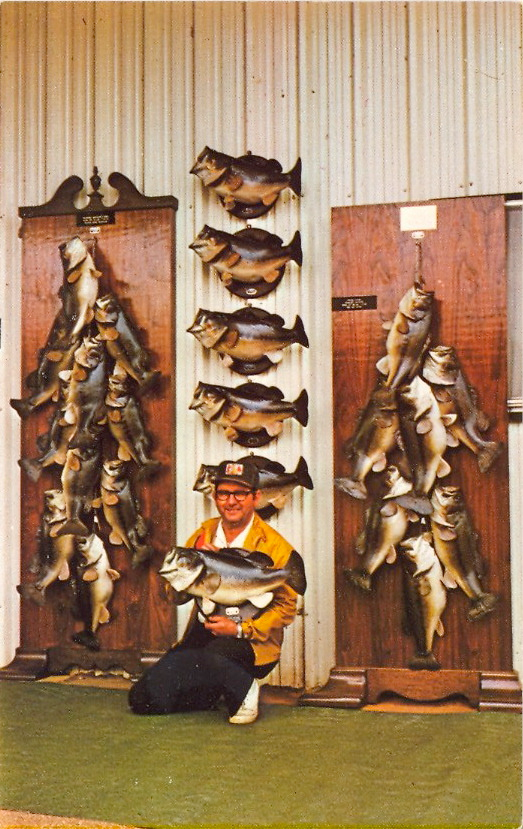
THE POT OF LUNKER BASS AT THE END OF THE RAINBOW
Raymond Gauthier has reached the end of the rainbow and has been justly rewarded with the fisherman’s pot of gold in these lunker bass caught on Toledo Bend Lake. On July 3, 1973, while fishing near Pendleton Bridge he hauled in 7 bass that tipped the scales at 56 pounds even. Since then he has caught 63 bass in a 2 acre area. 20 of these weighed over 6 pounds each, 20 more weighed over 7 pounds each and 12 of these weighed over 8 pounds each with the 2 biggest weighing 9 pounds 14 ounces each. Since then he has caught many more in the same weight range that have not been mounted.
[Postcard with caption found here.]
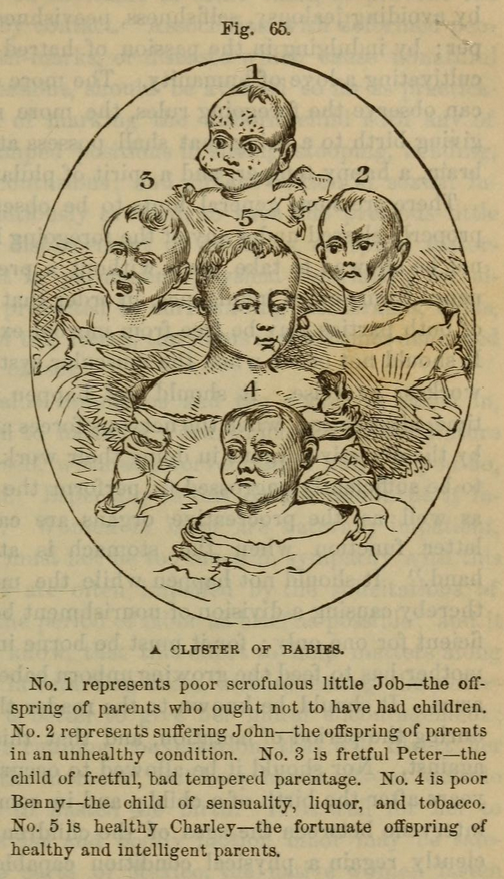
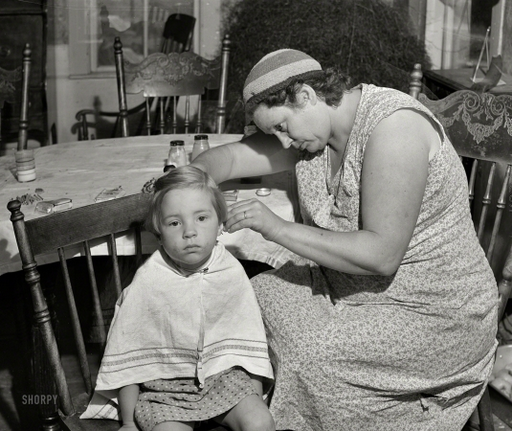
[Found on Page 223 of Plain Home Talk About the Human System—the Habits of Men and Women—the Cause and Prevention of Disease—Our Sexual Relations and Social Natures Edward Bliss Foote, 1896.]




 Tacky Raccoons