
[Found here.]

[Found here.]

[Found here.]
Fun Facts about Woodstock.
Buster Poindexter‘s weather report.
A cricket chirping, slowed down 800%.
The best advertisement for Tobasco Sauce ever.
Everyone should have The Happy Honk. [h/t MC]
Guy cashes in his Karma Points and walks away uninjured.
National Jukebox: Historical Recordings from the Library of Congress is very cool.
This is my new favorite song again because it fits my attitude.
Holland–Dozier–Holland. You’ve heard their stuff (including this).
Martha Reeves was born in Alabama, but pulled off a convincing British accent in this interview.
More George Orwell quotes here.
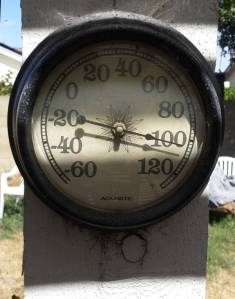
[Top image: The thermometer on our patio at 4PM Friday. Saturday morning I had to let the shower run until I got cool water. By Monday I’ll have changed my mind about getting a/c again until the next heat wave.]
God’s Cricket Chorus is awesome. I want that played at my funeral, by humans, followed by “Holiday For Strings.” played by crickets. [h/t Octopus]
Here’s Tom Waits‘ response when asked by NPR, “What is the most interesting recording you own?”
“It’s a mysteriously beautiful recording from, I am told, Robbie Robertson’s label. It’s of crickets. That’s right, crickets. The first time I heard it … I swore I was listening to the Vienna Boys Choir, or the Mormon Tabernacle choir. It has a four-part harmony. It is a swaying choral panorama. Then a voice comes in on the tape and says, “What you are listening to is the sound of crickets. The only thing that has been manipulated is that they slowed down the tape.” No effects have been added of any kind, except that they changed the speed of the tape. The sound is so haunting. I played it for Charlie Musselwhite, and he looked at me as if I pulled a Leprechaun out of my pocket.” [via]
In 1977 The Steve Gibbons Band covered Chuck Berry‘s 1969 recording of Tulane and did a decent job of it.
Amy Helm can wail, and her band jams it down your throat.
Third World‘s classic “96 Degrees In The Shade” seems appropriate given this week’s heat wave (and not for the political message).
Keep cool, folks, and we’ll see you back here tomorrow.
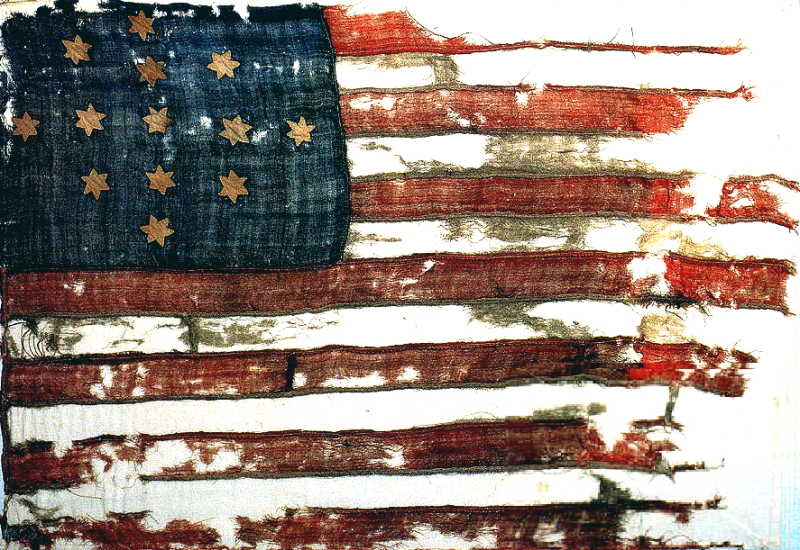
That’s the first known recording of John Philip Sousa‘s “The Stars And Stripes Forever March.” It was recorded by Kendle’s First Regiment Band on 29 December 1901 and published by Victor Records [source]. Sousa wrote in his autobiography that he composed the march on Christmas Day, 1896, while crossing the Atlantic, after he learned of the death of his band’s manager.
In 1987, an Act of Congress declared the song to be the Official National March of the United States of America.
Every person who supported cessation and fought for Independence from England was a British subject. Every person who fought against them were also subjects of The Crown. The American Revolution was fought by the British against the British.
The abuse of power by the King had become intolerable, and 13 individual colonies eventually banded together as one to fight the tyranny. The odds were not in their favor, and those colonists in the fray knew that they would be hung (or tortured to death) if they failed.
The Second Continental Congress convened in Philadelphia in the summer of 1775, shortly after the war with the British had begun. It was preceded by the First Continental Congress in the fall of 1774.
The Congress appointed George Washington as commander of the Continental Army, and authorized the raising of the army through conscription.
On July 4, 1776, the Congress issued the Declaration of Independence, which for the first time asserted the colonies’ intention to be fully independent of the mother country.
The Congress established itself as the central governing authority under the Articles of Confederation, which remained in force until 1788.
While sitting in pre-holiday traffic, I listened to The Mark Levin Show, and he played the audio of those two videos with commentary. I re-learned some history.
[More Independence Day posts in our archives.]

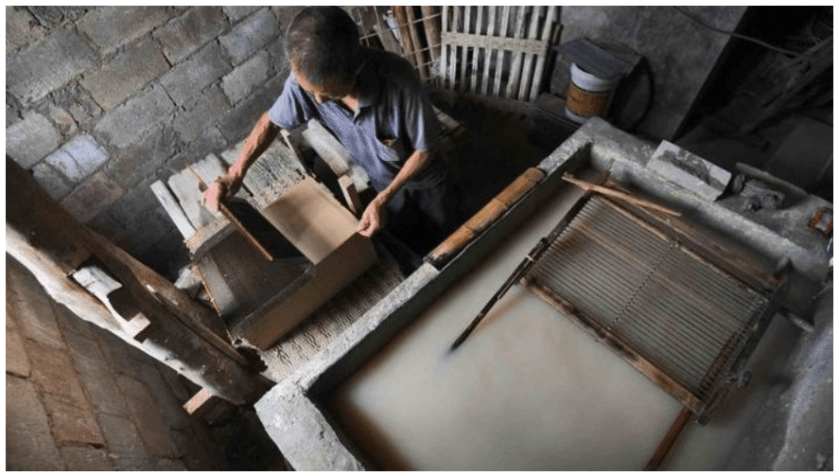

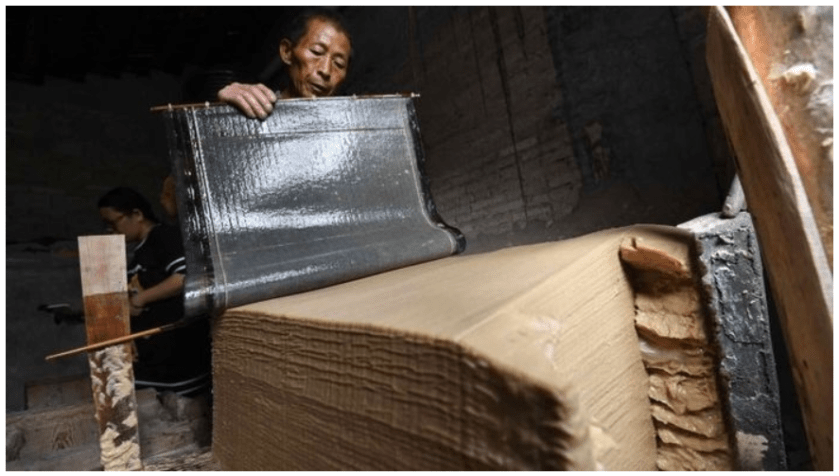
“A 65-year-old resident of a Chinese village named Huang Shiguo has been making paper according to old traditional technology for the last 36 years. According to him, for a month he produces about 3,000 sheets of such paper, earning about 9,000 yuan or 1,400 dollars.
[Huang] argues that paper made in a traditional way is much more durable, quality and soft compared to the manufactured methods. The master sells its products in the local markets of China.”
At time of posting, 9,000 yuan is equivalent to US $1,355, so each sheet of handmade paper earns him about 45 cents. Not bad, given the cost of living in rural China, but he’s not living in rural China. He’s demonstrating and preserving ancient technology, and selling his expensive product while living in a tourist mecca. Pure undiluted capitalism. Kudos.
“Huang Shiguo, 65, makes paper using ancient methods in his home in Baishui Village, Qiandongnan Miao and Dong Autonomous Prefecture, Southwest China’s Guizhou Province. Huang said he began learning the traditional paper-making craft at 29 and has been dedicated to the ancient craft ever since. Locals in the area have a more than 1,000-year history of paper making as the region is rich in Yangshan Bamboo, a main material needed for the craft. Huang said the typical process involves 72 steps and 55 days to produce paper.”
[Photos and 1st caption (translated from Russian via Google Translate) found here. 2nd caption from here.]





 Tacky Raccoons