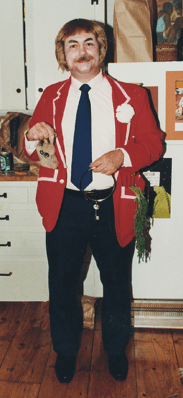
 In June of 2011, I found a photo of Captain Kangaroo with something interesting in the background and posted it as a tribute to the late Bob Keeshan. In October 2014 a comment appeared and “Dave” corrected me – that is NOT the Captain.
Dave, Monday, 20 October 2014, 8:05 AM
FYI, that IS a kitchen in a home — an old home — in Derry, New Hampshire. And that is not Bob Keeshan as Captain Kangaroo, rather another “Mr. Dressup” in a Halloween costume. The picture you found and “acquired” is from a Halloween party that took place in 1986, and that is NOT Captain Kangaroo’s Heineken on the counter!
Now, a mere 11-1/2 years later, the identity of the fake Captain is revealed. It was Dave himself!
09 February 2023 12:45am [via email]
Hi Bunk,
Back in 2014 I was doing an online search for pics of Bob Keeshan as the Captain, and was surprised to find shots of myself mixed in with pics of the real Captain. At that time I had a website set up to highlight years of Halloween costume pictures I had of myself, and I guess some had found their way onto the Internet search engines. That is when I discovered your website, and I was amused by the Heineken comment, and flattered that someone may have thought that my portrayal made them think that I was the real Captain. Little did I know that you found that picture a whole three years earlier.
Here are a few Captain photos, including the updated 1986 shot. That shot was taken at a friend’s home in NH, an old farmhouse. Our friend is a pro artist, and they had the house decorated in total Halloween mode, including a front yard graveyard and crooked shutters on the windows, a parlor with a coffin, and an oil painting on the wall depicting a knife-wielding character with blood dripping from the blade, across the frame, and onto the floor. Plus much, much more.
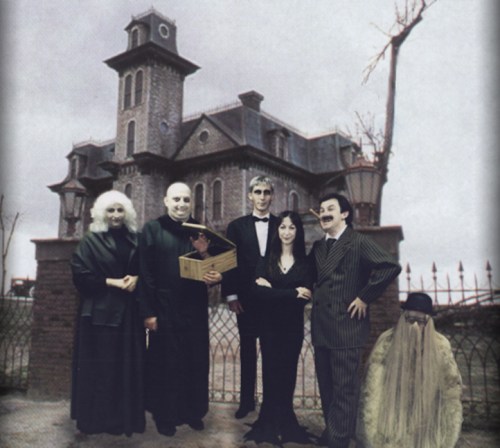
I rarely repeat a costume, but the Captain was a fave, so I repeated it nine years later. This time I rigged a box with a lid to contain Bunny Rabbit. A false, sleeved arm held the box so I could use my real hand to operate the puppet. I had gotten previous use of the box when dressed as the Addams Family’s Uncle Fester, with Thing (my real hand) in the box.
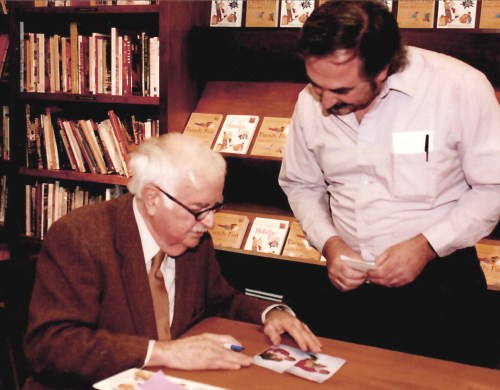
Coincidentally, shortly after doing my CK reprise, I heard from a friend that Bob Keeshan was coming to a local Barnes & Noble for a book-signing. I couldn’t pass on the opportunity to meet him and brought a few pictures to show him, and a camera to get some shots of him.
You are welcome to post these pics, if you like.
Enjoy,
Dave
[Update: Dave’s website link deleted at his request.]
Here are those photos. Thanks Dave!
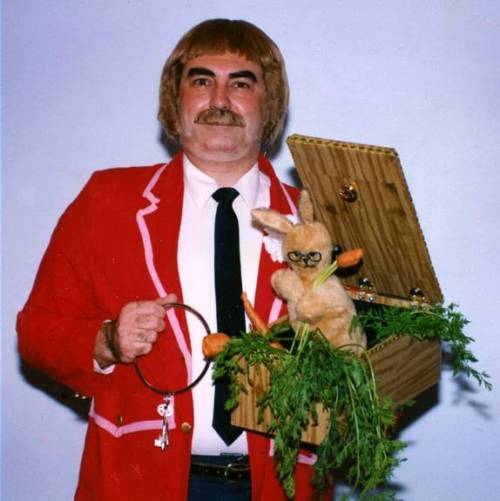

…and the Addams Family for the win: