
Hint: There’s no ramp to the 1st floor entry.
[Found here.]


Microfluidics are awesome.
From the What If This Were Your Business Department:
A family-owned Ohio bakery, founded in 1885, was falsely accused of racism by Oberlin College administration for calling police on young thugs, was awarded $11M in defamation case.
The 7th and 8th Commandments both apply here.
“Save the Planet” by cutting class? Reminded me of The List.
The President met with the Queen of England, and POTUS’ lack of decorum wasn’t reported .
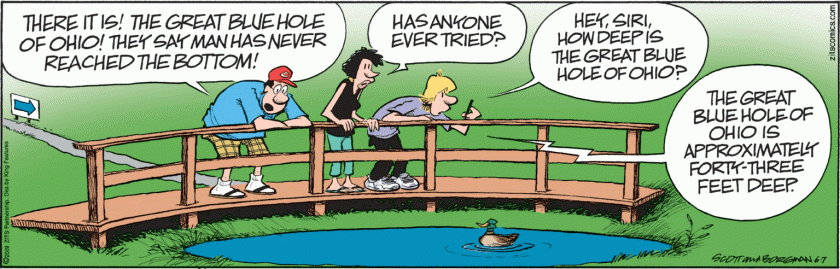
[Top image: The Big Blue Hole of Ohio. Bottom image from here.]
Goodbye Mr. Snuggles. (Impressive credits roll, too.)
Stan Ridgway and Wall of Voodoo were unusual for the time. They weren’t prolific, but I liked what they did.
Filmed & Recorded on May 4, 2019 at the Dallas International Guitar Festival
Red House is pure awesome, but I can’t find a direct link to the band.
Kelsi Kee – Vocals
Reece Malone – Guitar
Ally Venable – Guitar
Anthony Cullins – Guitar
Danny Ross – Keys
Mike Gage – Drums
Aram Doroff – Bass
Holy crap. I just found this. So heavy and nasty.
Have a great weekend, folks. See you back here tomorrow for more awesome.
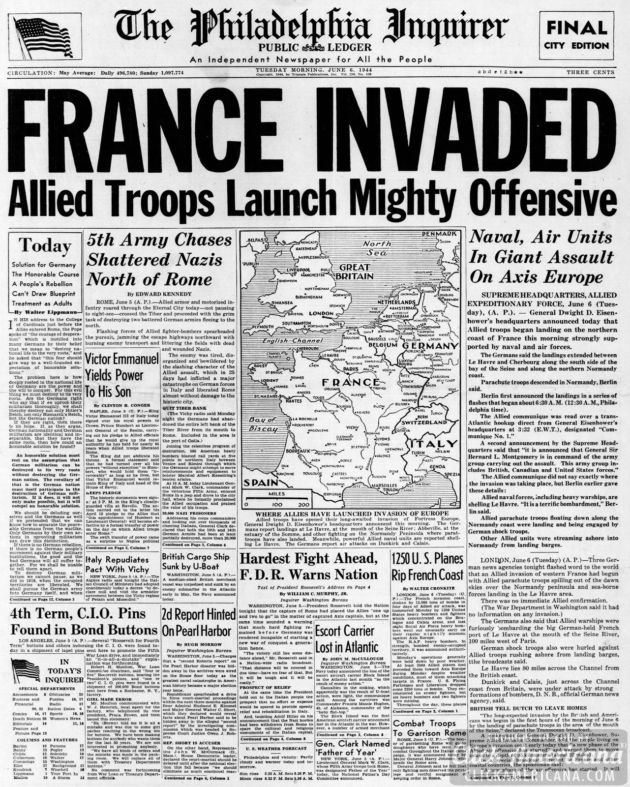
In 1944, and against the odds, General Dwight D. Eisenhower accepted the risk and subsequent bloodshed in order to prevent more of it. His leadership freed France from Nazi Germany occupation and was the beginning of the end of the war in Europe.
General Eisenhower was mocked by the left, portrayed as a dullard, stupid and ignorant. He wasn’t. Not by a long shot.
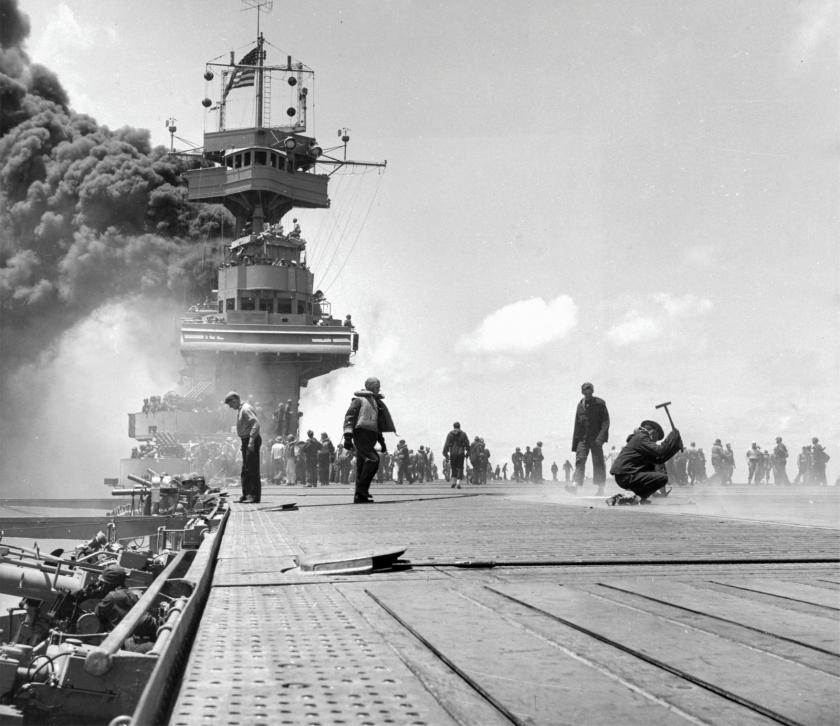
77 years ago, The Battle of Midway dramatically changed the outcome of WWII in the Pacific.
An out-gunned flotilla of US warships took advantage of information provided by Joe Rochefort‘s codebreakers and caught Imperial Japan’s massive attack force off guard. It was perhaps the most decisive battle in naval history.
By mid-1942, Rochefort’s codebreakers could read much of the Japanese Purple Code (Rochefort was fluent in the language) and they knew that an attack was imminent on “AF” but they didn’t know where AF was. They arranged that an un-encrypted message be sent from Midway Island claiming that the desalinization plant was down and the island was almost out of fresh water (it wasn’t).
Japanese intelligence intercepted the alert and sent coded messages that “AF” was out of water, and the codebreakers confirmed that “AF” was Midway. Rochefort’s team also predicted the direction that Admiral Admiral Yamamoto’s armada would attack from.
It wasn’t an easy fight. The U.S. Navy lost the USS Yorktown, the destroyer USS Hammann (DD-412), and nearly 150 aircraft. More than 300 Sailors were killed or injured. But when you stack it up against Japanese losses (four carriers, a heavy cruiser, more than 300 planes, and some 2,500 casualties) there’s little room for doubt as to who won.
Admiral Yamamoto’s armada was successfully ambushed while attempting to ambush the US Navy.
[Image and quote from here. More at the links above.]
P.S. If you think Hollywood’s version of Midway is accurate, it’s not.

[Found here.]

I’m pretty sure they meant “Donut Animals,” or “No Fish Hands.”
I dunno, Babs, but I do know this.
[Found here.]
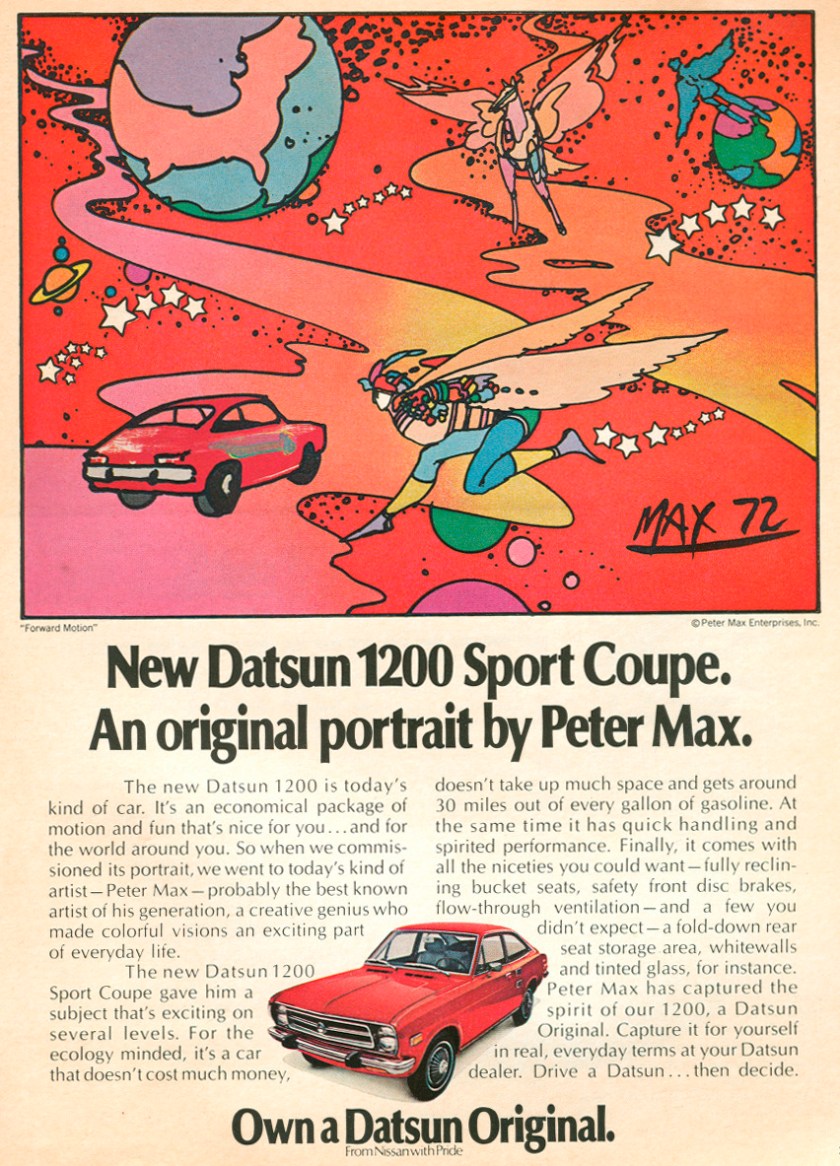
The exploitation of Peter Max.
Cool EcoVid, but why the porn soundtrack?
Desert Blues – Jimmy Rogers, 1929.
Desert Blues – Skeets McDonald, 1965.
Desert Blues – Ricky Nelson, 1967.
Desert Blues – Leon Redbone, 1975.
More versions listed here.
If in Riverside, California, take this tour.
If in Wilmington, Delaware, take this tour.
If in Lynchburg, Tennessee, take this tour.
Max Mueller II, mayor of Idyllwild, California, is a real SOB and everyone knows it.
Mom ordered a t-shirt from China for her 3-year-old and it came with a surprise bonus feature.
And it’s all supposed to be spontaneous. Yeah, right.
Un-Aborted Pro-Abortion woman tries to make the argument:
“Let’s eliminate suffering by killing those who MIGHT suffer.” Pheew. Even Planned Parenthood founder Margaret Sanger was against abortion as a contraceptive (except for blacks). The entire premise is false.
From the archives: 10 years ago. 5 years ago. 1 year ago.
[Top image from here.]
Leon Redbone was an iconic performer who reinvigorated the music of the late 19th to early 20th century, including blues, ragtime, dixieland jazz and country. That he pulled it off in the mid 1970s is an interesting commentary of the state of music of the time (mainstream rock was sucking donkeys). You couldn’t get more retro than Leon Redbone at that time, and he stepped right into the mix.
Rolling Stone described his repertoire as “so authentic you can hear the surface noise of an old 78 rpm.” During a 1974 interview (prior to release of any album) they asked where he first played in public. Redbone responded, “In a pool hall, but I wasn’t playing guitar, you see. I was playing pool.” Apparently he was pretty good at it.
I learned of the song “Ain’t Misbehavin‘” via some sheet music my late grampa had, and I liked the tune. I’d never heard of Fats Waller before I heard Leon Redbone’s version.
Then I heard Redbone’s over-the-top absurd version of The Sheik of Araby, a cover of this (1937) which was a cover of this (1922). I became a fan.
In the early ’80s I saw Mr. Redbone perform at The Golden Bear (a small but famous venue with no bad seats). His props were a rattan chair, a side table with a lamp, and his guitar. He was in the middle of a song when he saw the flash of a Kodak Instamatic camera. With lightning speed, he stopped, grabbed a Polaroid Swinger and took a photo of the photographer, then sat quietly humming until the image appeared. He held it up to view.
“Ahhh. Not a bad likeness.”
Then he resumed the song exactly where he left off.
I wasn’t aware of this until today, but there is a documentary on Leon Redbone. Here’s the trailer:
“He was always mysterious, he was always coming and going. It was almost like he was there one second and he’d be gone the next… and you never knew where he’d gone or why or how he’d even left, but suddenly he wasn’t there anymore.” – Jane Harbury, Publicist.
Here’s a link to the full documentary if you’re interested. It’s only 16 minutes, but it’s worth it.
Leon Redbone, you were a breath of fresh air into the stagnant late 70s music scene. May You Rest In Peace.
[Related posts here.]



 Tacky Raccoons